

A vanilla frosting donut is a donut (usually yeast-raised or cake-style) topped with vanilla icing. Depending on where you buy it, that topping may be called vanilla frosting, vanilla glaze, vanilla icing, vanilla dip, or even vanilla fondant.
In plain terms: it’s the classic “white-iced donut”—often finished with rainbow sprinkles—built to be sweet, mild, and universally appealing.
The fastest definition (quick answer)
A vanilla frosting donut is a yeast or cake donut topped with vanilla icing—either a thin vanilla glaze that sets firm or a thicker frosting-style coating that stays creamy and soft.
Why this donut matters (and why it’s always on the menu)
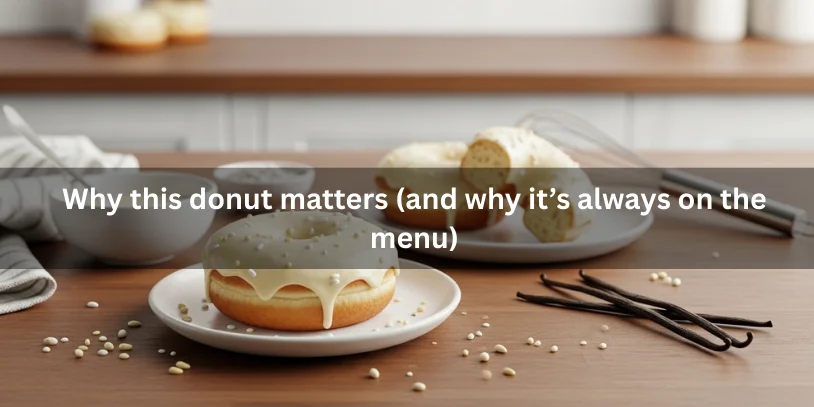
Vanilla sounds simple, but it solves a lot of real-world “donut problems”:
- It’s the crowd-pleaser. If you’re ordering for a group, vanilla is the safest default.
- It’s a customization base. Sprinkles, crushed cookies, toasted coconut, or fruit fillings all work.
- It hits texture contrast. A soft donut + a sweet, smooth top is classic comfort-food engineering.
It’s also one of the easiest donuts for bakeries and cafés to standardize, which is why it shows up everywhere—from independent donut shops to big brands like Dunkin’, Tim Hortons, and Krispy Kreme.
Who it’s for (and when it’s the best choice)
Best for
- Kids’ parties (sprinkle donuts win photos and picky eaters)
- Office meetings (mild flavor, broad appeal)
- Events and catering (pairs well with coffee and tea, easy to mix into assorted boxes)
- Anyone who doesn’t want intense flavors like maple, mocha, or heavy spice
When it shines
- Freshness windows: morning to midday, when turnover is high
- Same-day serving: vanilla frosted donuts don’t improve with time—texture is everything
Types of vanilla frosting donuts (know what you’re actually ordering)
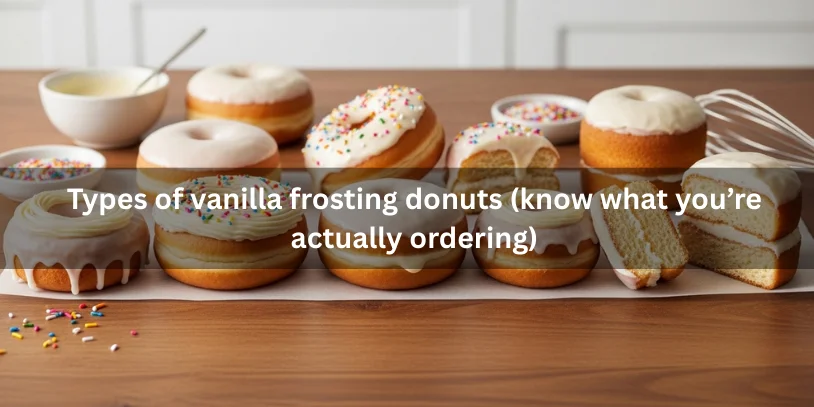
The two biggest variables are the donut base and the coating style.
Yeast-raised vs cake donut
| Feature | Yeast-raised vanilla frosted donut | Cake vanilla frosted donut |
|---|---|---|
| Texture | Light, airy, pull-apart | Denser, tender crumb |
| Sweetness feel | Often tastes less sweet (more air) | Often tastes sweeter (more bite) |
| Best for | “Classic donut shop” experience | Coffee pairing, sturdier handling |
| Staling | Can stale faster | Often holds up slightly longer |
Simple pick:
- Choose yeast-raised if you want fluffy and light.
- Choose cake if you want a firmer bite that travels better.
Frosting vs glaze vs icing vs fondant (yes, these matter)
Different shops use different words, but the behavior is what matters—especially for delivery.
| Coating name (common) | Thickness | Sets firm? | Smear risk | Best use |
|---|---|---|---|---|
| Vanilla glaze | Thin | Yes | Low | Delivery, stacking, warm climates |
| Vanilla icing (general) | Medium | Depends | Medium | All-purpose |
| Vanilla frosting (buttercream-style) | Thick | No/soft | Higher | Indulgent, eat soon, cool storage |
| Vanilla fondant | Thick & smooth | Yes-ish | Medium | Clean look, strong shelf appearance |
If you’ve ever opened a box to find icing stuck to the lid, you’ve met the difference.
What to look for in a “best” vanilla frosting donut
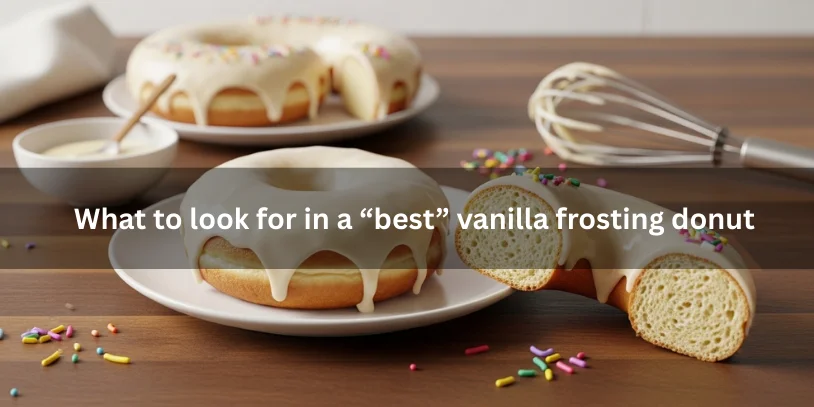
A great vanilla frosting donut isn’t just “sweet.” It’s about balance, freshness, and coating control.
Freshness cues you can spot fast
- Weight: should feel light for its size, not oily-heavy
- Surface: evenly browned, not pale with a raw center ring
- Coating: set and smooth, not wet, sliding, or “sweating”
- Aroma: vanilla-forward (not just sugar)
One question that saves you money
If you’re buying in person, ask:
- “What time were these iced today?”
Shops with high turnover will answer confidently. If the answer is vague, pick a different batch.
Buying guide: choose the right vanilla frosting donut for your situation
Decision framework (quick)
- Eating immediately? Go thick frosting (creamier, richer).
- Taking it to work or school? Go glaze or fondant (cleaner, less mess).
- Ordering delivery? Avoid very soft frosting in hot/humid weather.
- Serving a group? Get a mix: yeast + cake + sprinkles + one filled option.
“Near me” buying options (works globally)
People often search this as a local intent query even when the phrase doesn’t include a city. Use these patterns:
- “vanilla frosting donut near me”
- “best vanilla frosted donut in [city]”
- “donut delivery in [city]”
- “custom sprinkle donuts near me”
This works whether you’re in New York City, London, Toronto, or Karachi.
Where to buy (and what each is best at)
- Independent donut shops: best freshness, customization, seasonal toppings
- Bakery chains: consistent product, clear allergen/nutrition info
- Cafés/coffee chains: convenient, limited selection, decent baseline
- Supermarkets/hypermarkets: budget-friendly, freshness varies
- Delivery-first dessert brands: convenient, frosting stability varies—choose glaze/fondant for safer transport
Pricing: what it “should” cost (and what changes the price)
There isn’t one global price for a vanilla frosting donut. The cost depends on:
- Ingredient quality (butter, real vanilla extract vs vanilla flavoring)
- Size (mini vs standard vs jumbo)
- Toppings (sprinkles, cookies, drizzles)
- Filling (custard, cream, jam adds cost)
- Packaging and delivery distance
- Seasonal demand (holidays, school events)
Practical rule of thumb
If two shops are in the same neighborhood and one is dramatically cheaper, you may be trading off:
- donut size
- freshness (stale product discounted)
- ingredient quality
- frosting thickness/top coverage
donut with white frosting
Here’s a simple donut with white frosting recipe (classic, bakery-style taste, easy at home).
Soft Donuts + White Vanilla Frosting (Glaze)
Donuts (baked, no frying)
Ingredients
- 1 cup (125g) all-purpose flour
- 1/3 cup (65g) sugar
- 1 tsp baking powder
- Pinch salt
- 1 egg
- 1/2 cup (120ml) milk
- 2 tbsp melted butter (or oil)
- 1 tsp vanilla
Steps
- Oven 180°C / 350°F. Grease donut pan.
- Mix dry ingredients. In another bowl mix egg, milk, butter, vanilla.
- Combine (don’t overmix). Pipe/spoon into pan.
- Bake 10–12 min. Cool 10 min.
White Frosting (classic donut glaze)
- 1 cup (120g) powdered sugar
- 2–3 tbsp milk (add slowly)
- 1/2 tsp vanilla
- Tiny pinch salt (makes it taste “bakery”)
Mix until smooth and thick-but-dippable. Dip cooled donuts, let set 10–15 minutes.
Nutrition and allergens: what to check before you order for a group
Calories vary widely
A vanilla frosted donut can range from “moderate” to “dessert-heavy” depending on:
- yeast vs cake base
- amount of icing
- sprinkles/fillings
- donut size
Big chains publish nutrition matrices, but values differ by country and recipe. Treat any single number as an example, not a universal truth.
Common allergens and cross-contact
Most vanilla frosting donuts contain or may contain:
- wheat/gluten
- milk
- eggs
- soy (often in emulsifiers/chocolate toppings)
- sometimes sesame or nuts depending on the kitchen and toppings
If you’re ordering for an event, ask:
- “Do you have allergen information for this donut?”
- “Is there cross-contact in shared fryers or prep areas?”
That question matters most for kids’ parties and office catering.
Frosting failure modes (and how to prevent them)
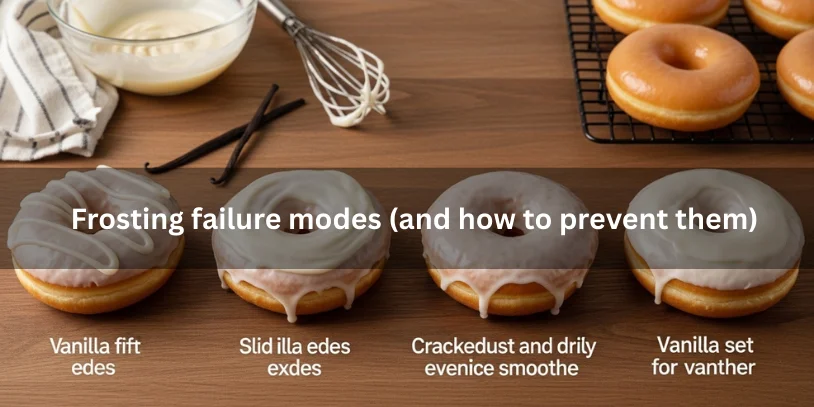
If you’ve ever had a donut arrive messy, these are the usual culprits.
1) Melt
What happens: frosting softens and slides.
Why: warm donut, warm room, warm delivery car.
Fix
- Frost only when donuts are fully cool (for thick frosting).
- Choose glaze or fondant for delivery in warm weather.
- Ask for separate frosting cups if the shop offers it.
2) Sweat
What happens: icing looks wet and sticky.
Why: condensation from temperature swings (cold-to-warm).
Fix
- Avoid moving boxed donuts from fridge to hot air too quickly.
- Keep them in a consistent cool environment until serving.
3) Slip (icing slides off)
What happens: smooth top peels away.
Why: icing too thin or donut surface too oily/warm.
Fix
- Thicken icing slightly (more powdered sugar) for home recipes.
- Let fried donuts drain and cool before icing.
4) Stick (to lid or paper)
What happens: the best part stays on the box.
Why: icing not set or packaged too tightly.
Fix
- Give glaze time to set before boxing.
- Use single-layer boxing for thick frosting donuts.
Make vs buy: the simplest way to get the result you want
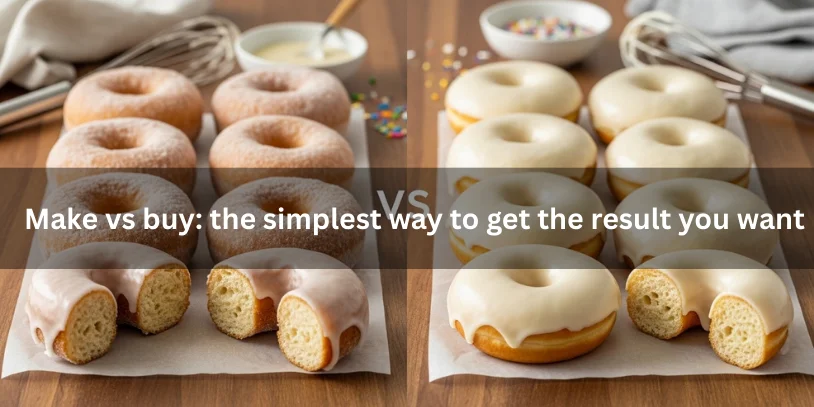
If you want the classic donut-shop texture, frying yeast donuts is unbeatable—but it’s also the most effort.
Here are two dependable paths.
How to make baked vanilla frosted donuts (easy, beginner-friendly)
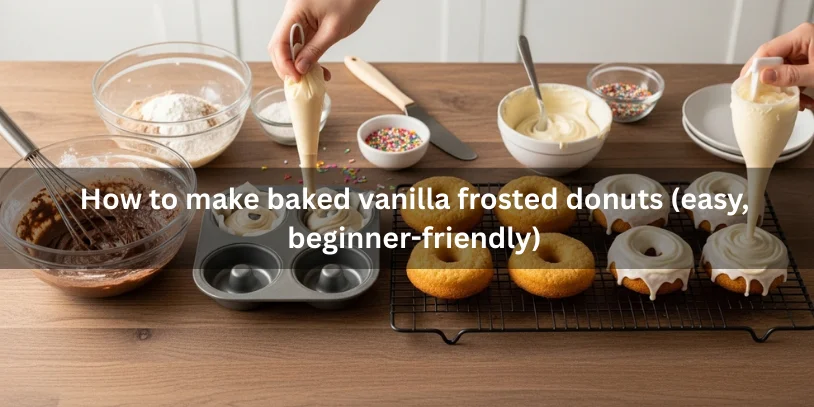
Best for: consistent results, quick cleanup
Texture: cake-like
Tools
- donut pan
- mixing bowl + whisk
- piping bag or zip-top bag (for neat filling)
Base steps
- Mix dry ingredients (flour, sugar, leavening, salt).
- Whisk wet ingredients (milk, egg, melted butter or neutral oil, vanilla).
- Combine gently—stop mixing when you don’t see dry flour.
- Pipe into donut pan (don’t overfill).
- Bake until springy to the touch.
- Cool completely before thick frosting.
How to make classic vanilla icing for donuts (glaze or frosting-style)
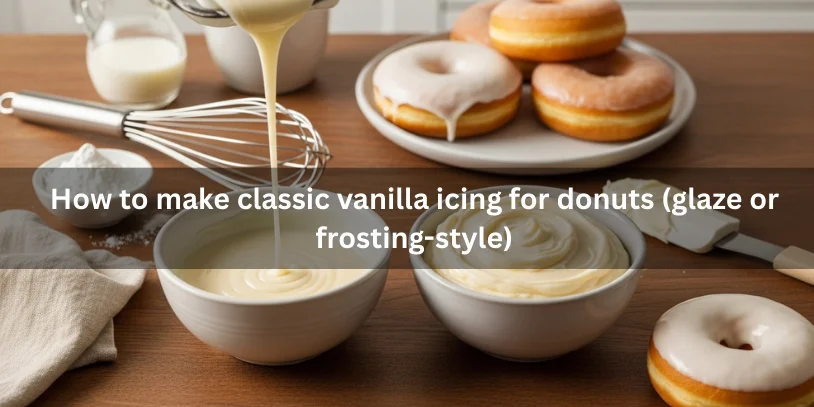
This is where most home attempts go wrong: icing consistency.
Option A: Vanilla glaze (sets cleaner)
Best for: stacking, transport, warm kitchens
Method
- Whisk powdered sugar with a splash of milk.
- Add vanilla extract.
- Adjust: more sugar = thicker; more milk = thinner.
- Dip donut tops, lift, let excess drip.
- Let set before boxing.
Option B: Vanilla frosting-style icing (thicker, creamier)
Best for: rich “cupcake top” feel
Method
- Beat softened butter until smooth.
- Beat in powdered sugar gradually.
- Add vanilla and a small splash of milk to loosen.
- Spread or dip (dip works best when frosting is silky, not stiff).
- Add sprinkles immediately so they stick.
Consistency tip: You want one-dip coverage without tearing the donut surface. If it’s ripping the top, it’s too thick.
Storage and transport: keep it fresh and intact
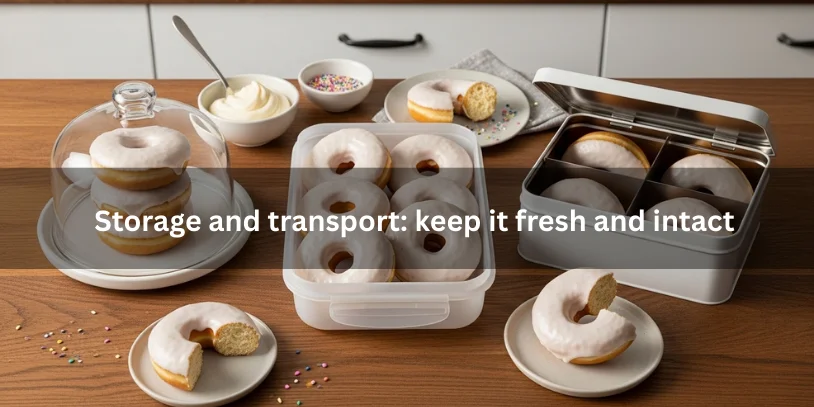
How long do vanilla frosting donuts stay fresh?
They’re best the same day. After that:
- yeast donuts lose softness faster
- cake donuts can hold structure a bit better
Storage rules that actually work
- Short term (same day): room temperature in a box, away from heat and sunlight
- Overnight: airtight container helps, but expect texture change
- Avoid stacking: especially for thick frosting or sprinkles
- Transport: single layer, stable temperature, minimal jostling
If the goal is “still looks perfect when opened,” glaze and fondant are safer than soft frosting.
Ordering for events: quick planning (B2C and B2B)
Vanilla frosting donuts are event-friendly because they scale well—especially with sprinkles.
Event box strategy
- 40–50% vanilla frosted/vanilla sprinkle (safe choice)
- 20–30% chocolate frosted (crowd favorite)
- 10–20% filled donuts (premium feel)
- a few glazed (clean, less messy)
Customization ideas that work globally
- Holiday sprinkles (seasonal colors)
- Cookie crumble topping
- Coconut flakes
- Fruit drizzle (strawberry/raspberry)
If you’re a bakery or café, the menu benefit is obvious: one base donut + multiple topping SKUs.
Vanilla frosting donut alternatives (if you want a different vibe)
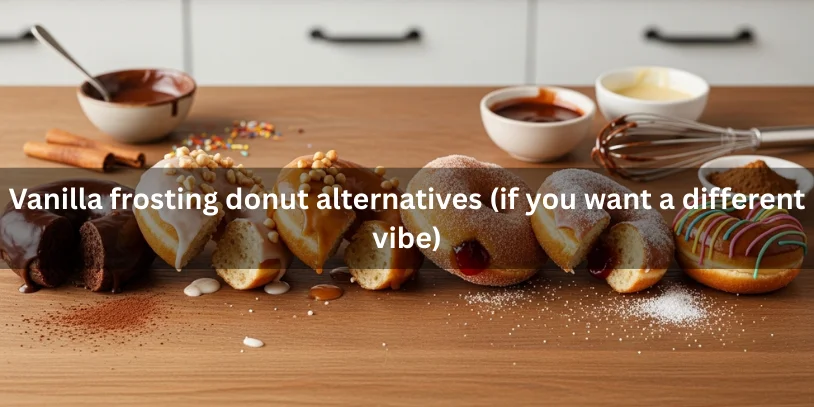
- Classic glazed donut: less messy, pure donut flavor
- Powdered sugar donut: travel-friendly, less sticky
- Chocolate frosted donut: stronger flavor, often richer
- Maple iced donut: bold aroma and deeper sweetness
- Old-fashioned donut: craggy texture, great with coffee
People ask these questions (and the real answers)
Is a vanilla frosted donut the same as a glazed donut?
Not exactly. Glaze is thinner and usually sets firm and shiny. Frosting is thicker and softer, with more smear risk—especially in heat or delivery.
What’s a “vanilla dip” donut?
Many shops use “vanilla dip” to describe a donut dipped in vanilla icing or fondant. It’s essentially a vanilla iced donut, often finished with sprinkles.
Is fondant different from frosting?
Yes. Fondant-style icing is smoother and tends to set more than buttercream-style frosting. That’s why it’s common on donuts that need a clean, uniform finish.
Which donut base is best for vanilla frosting?
If you want airy and light, choose yeast-raised. If you want sturdy and travel-friendly, choose cake. For thick frosting, cake donuts often hold up better.
Why did my homemade donuts turn out dry?
Overmixing batter, overbaking, or inaccurate measuring can dry them out. Mix gently, bake just until springy, and consider weighing ingredients for consistency.
Why did my donuts brown too much?
Oven hot spots, pan placement, or overbaking are common causes for baked donuts. For fried donuts, oil temperature that’s too high can over-brown the outside before the inside cooks.
How do I keep frosting from melting or sliding?
Cool donuts fully before thick frosting, choose glaze/fondant for delivery, and avoid big temperature swings that cause sweating and stickiness.
FAQs
- What is a vanilla frosting donut?
A donut (yeast-raised or cake-style) topped with vanilla icing—ranging from thin glaze to thick frosting—and often finished with sprinkles. - Which is better: yeast or cake vanilla frosted donut?
Yeast is fluffier and lighter; cake is denser and usually travels better. Your “best” depends on texture preference and how soon you’ll eat it. - What’s the difference between icing, glaze, frosting, and fondant on donuts?
Glaze is thin and sets firm; frosting is thick and creamy; icing is a general term; fondant is smooth and often sets more than frosting. - How can I find the best vanilla frosting donut near me?
Search “best vanilla frosting donut in [city]” and prioritize shops with high turnover, fresh-made batches, and clear icing set (not wet or sliding). - How do I store vanilla frosted donuts overnight?
Use an airtight container at room temperature if possible, avoid stacking, and expect some texture change. Yeast donuts stale faster than cake donuts. - Why does frosting sometimes sweat or get sticky?
Condensation from temperature changes (cold to warm) can create a wet surface. Keep donuts at a stable temperature until serving. - Are vanilla frosting donuts allergy-friendly?
Often not. Many contain wheat/gluten and may include milk, eggs, and soy, with possible cross-contact. Ask the shop for allergen information before ordering for groups. - What’s the easiest way to make vanilla frosted donuts at home?
Bake cake-style donuts in a donut pan and use a vanilla glaze or simple frosting-style icing. It’s faster and cleaner than frying for most beginners.
Conclution
A vanilla frosting donut looks simple, but the best versions are all about smart choices: yeast vs cake, glaze vs frosting vs fondant, and freshness vs travel needs. If you’re buying, prioritize high-turnover batches and coating stability for delivery. If you’re making them, nail the icing consistency and timing—cool donuts for thick frosting, glaze for clean transport. Either way, it’s one of the easiest, most reliable treats to please a crowd.