

If your cannoli filling is too loose, the fastest fix is simple: drain the ricotta, chill the filling, and only then adjust it with confectioners’ sugar or a small amount of mascarpone if needed. In most cases, the real problem is excess moisture, not a lack of sweetness.
Cannoli filling should be thick, smooth, and pipeable. It should hold its shape in a piping bag, sit neatly inside cannoli shells, and stay creamy without turning watery or making the shell soggy. When it doesn’t, the culprit is usually one of four things: wet ricotta, the wrong ricotta, overbeating, or filling the shells too early.
Fix it now: the best way to thicken cannoli filling fast
If you need to rescue the filling before guests arrive, use this order:
- Chill the filling for 30 to 60 minutes
- Re-strain it through a fine-mesh sieve lined with cheesecloth
- Add a small amount of powdered sugar or mascarpone only if it still feels too loose
That sequence works because chilling firms the dairy, draining removes excess liquid, and the final adjustment fine-tunes texture without throwing the flavor off.
A quick decision table
| If your filling looks like this | Most likely cause | Best fix |
|---|---|---|
| Slightly loose but still creamy | Not chilled enough | Refrigerate 30–60 minutes |
| Watery or weeping | Ricotta too wet | Re-strain through cheesecloth |
| Loose and bland | Wet ricotta + under-sweetened | Drain, then add confectioners’ sugar gradually |
| Soft but rich | Normal ricotta texture, needs more body | Fold in a little mascarpone |
| Thick enough now, but shells go soft | Filled too early | Pipe just before serving |
Why cannoli filling gets runny in the first place
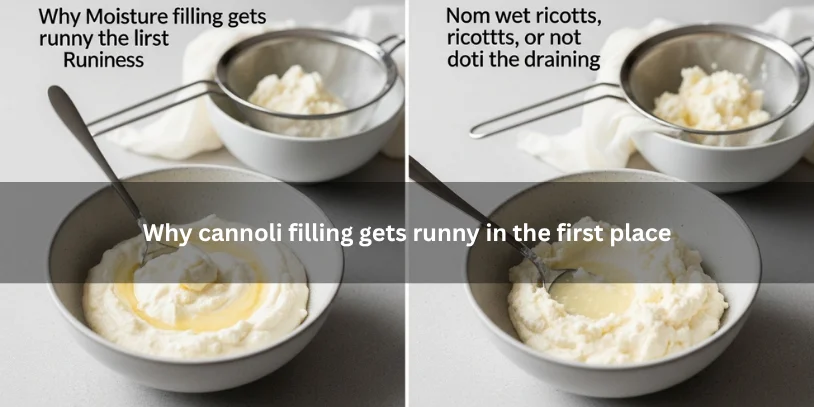
Traditional Sicilian cannoli filling is built around ricotta, often sheep’s milk ricotta when available. In many countries, though, home bakers use supermarket cow’s milk ricotta, and that’s where texture problems start.
The most common causes
1. The ricotta has too much moisture
Not all ricotta cheese is the same. Some tubs are soft, wet, and full of whey. Others are lower-moisture and better for pastry work. If your ricotta is wet straight from the container, your filling will almost always end up runny.
2. You skipped the draining step
For thick cannoli cream, ricotta usually needs time in a fine-mesh strainer or cheesecloth-lined sieve. A short drain can help, but draining overnight gives the best control.
3. You used regular ricotta instead of ricotta impastata
Ricotta impastata is smoother, drier, and much better for cannoli. It gives a more stable filling and a more polished bakery-style texture. If you can find it at Italian markets or specialty cheese shops, it is one of the best upgrades you can make.
4. You overmixed the filling
Overbeating can break down the texture and make the mixture seem looser. Cannoli filling does not need aggressive whipping. Gentle folding is better.
5. You filled the cannoli shells too early
Even a perfectly thick filling can soften crisp shells if it sits inside them too long. Fill just before serving if you want that classic contrast between creamy filling and crisp shell.
The best ricotta for cannoli filling
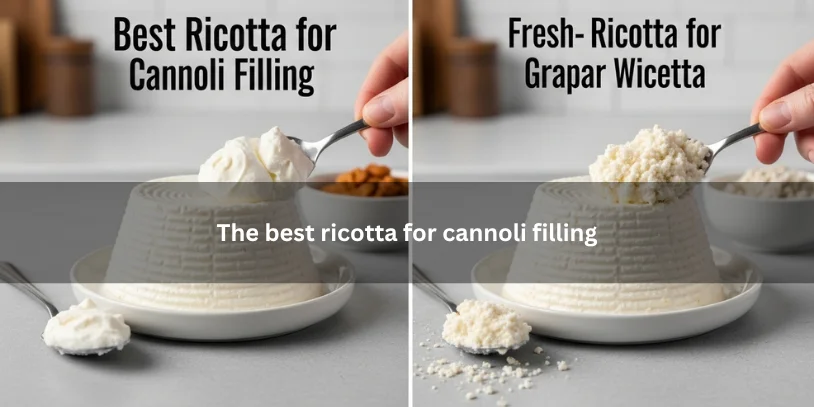
If you want consistent results, ricotta choice matters almost as much as technique.
Best options, from most traditional to most practical
Sheep’s milk ricotta
This is closest to the traditional Sicilian style. It has excellent flavor and can produce a rich, authentic filling, but it is harder to find outside Italy and outside neighborhoods with strong Italian grocery options.
Ricotta impastata
For texture, this is often the top choice. It is smoother and lower-moisture than standard ricotta, which means less draining, less graininess, and a more stable pipeable filling.
Whole-milk ricotta
This is the best mainstream option for most home bakers. It has better body than skim ricotta and gives a fuller taste.
Low-quality additive-heavy ricotta
This is the riskiest choice. Some supermarket brands include stabilizers, gums, or preservatives that affect texture. They may seem convenient, but they can give you a filling that feels watery, gummy, or oddly grainy.
How to drain ricotta properly
If you only change one thing, make it this step.
What you need
- Fine-mesh strainer or sieve
- Cheesecloth or a clean thin kitchen towel
- Bowl
- Refrigerator space
The method
- Line the sieve with cheesecloth.
- Spoon in the ricotta.
- Set the sieve over a bowl so liquid can drip away.
- Cover and refrigerate.
- Drain for at least 1 hour for a quick fix, or overnight for best results.
If the ricotta is extremely wet, lightly press it after draining, but do not mash it. You want to remove moisture, not compress it into a dense paste.
Traditional method vs modern shortcut

There is a real contradiction in cannoli filling advice, and it helps to separate the approaches clearly.
| Method | Texture | Flavor | Best for |
|---|---|---|---|
| Drained ricotta only | Authentic, slightly rustic to smooth | Most traditional | Classic Sicilian-style cannoli |
| Ricotta impastata | Silky and stable | Traditional pastry profile | Bakery-style results |
| Ricotta + mascarpone | Thicker and richer | Slightly less traditional | Home bakers who want easy texture control |
| Ricotta + pudding or cornstarch | Very stable, less classic | Noticeably modern | Emergency shortcut only |
Which one should you choose?
- If authenticity matters most, stick with drained ricotta or ricotta impastata
- If you need reliable body with supermarket ingredients, use whole-milk ricotta plus a little mascarpone
- If you are in an emergency and only care about stability, shortcut methods can work, but the flavor moves away from classic cannoli
How to make the filling smoother, not grainy
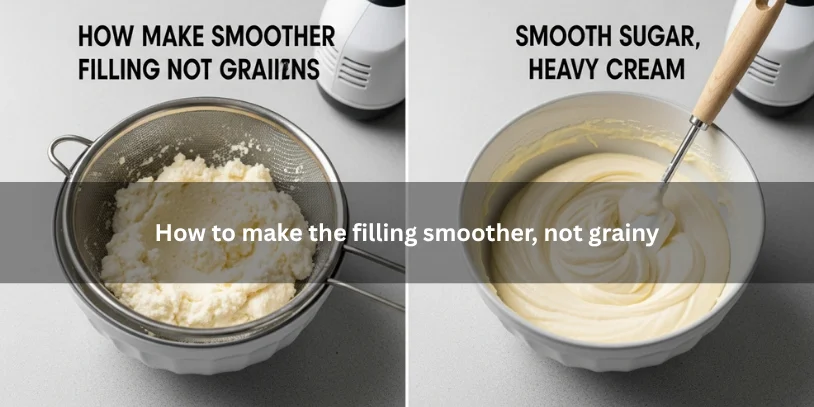
A lot of people ask whether cannoli filling should be perfectly smooth. The answer is: not always. Authentic cannoli filling can have a slight ricotta texture. But if it is gritty, clumpy, or unpleasantly grainy, improve it with one of these methods:
Use a fine sieve
Passing drained ricotta through a fine-mesh strainer helps create a silky texture.
Use better ricotta
Lower-moisture ricotta and ricotta impastata naturally produce a smoother cream.
Mix gently
Do not overwork the filling in a food processor or mixer.
Rest it overnight
A chilled overnight rest can improve mouthfeel and help the confectioners’ sugar blend more evenly.
Should you use powdered sugar or granulated sugar?
For most cannoli filling, confectioners’ sugar is the better choice.
Why powdered sugar works better
- It dissolves faster
- It blends more smoothly
- It helps tighten texture slightly
- It is less likely to leave the filling sandy
Granulated sugar can work, but it often needs more time to dissolve and can leave a coarser feel. If your goal is thick, pipeable, and smooth, powdered sugar is the safer route.
That said, sugar alone should not be your main thickening strategy. If the filling is watery, draining the ricotta is still the fix that matters most.
Does mascarpone make cannoli filling thicker?

Yes, it does.
Mascarpone adds richness, body, and stability. It is especially useful when you only have wet supermarket ricotta and need a more dependable texture. It also makes the filling feel silkier.
The trade-off is that mascarpone pushes the filling away from the pure traditional Sicilian profile. That does not make it wrong. It just makes it a modern variation rather than the strict classic version.
A good rule is to use mascarpone as a support ingredient, not the main cheese.
How to keep cannoli shells crisp
Thick filling helps, but shell timing matters just as much.
For crisp shells:
- Fill the cannoli just before serving
- Keep shells and filling stored separately
- Use a piping bag for clean, fast filling
- Avoid letting filled shells sit uncovered in the refrigerator for hours
This is especially important if you garnish with mini chocolate chips, chopped pistachios, candied orange peel, or citrus zest. Those toppings add wonderful flavor, but they do not stop moisture from softening the shell.
Can you make cannoli filling ahead of time?

Yes, and in many cases it gets better after resting.
A make-ahead rest lets the filling chill, firm up, and settle. It can also help the flavor come together, especially if you’re using vanilla, cinnamon, orange blossom water, lemon zest, or candied orange peel.
Best make-ahead approach
- Make the filling 1 day ahead
- Keep it chilled
- Store it in an airtight container
- Stir gently before piping
- Fill shells right before serving
If the filling seems looser the next day, it usually means the ricotta was still too wet to begin with. Drain longer next time.
What to use when you can’t find ricotta impastata
Outside Sicily or outside large Italian food hubs, ricotta impastata can be hard to find. If you search for ricotta impastata near me, Italian market near me, or specialty cheese shop near me, you may find it locally, but many home bakers won’t.
Here’s the best fallback plan:
- Buy the best whole-milk ricotta you can find
- Choose a brand with fewer additives
- Drain it overnight
- Pass it through a fine sieve
- Add a little mascarpone only if needed
That gives you a very good substitute for pastry-grade ricotta without forcing a complicated workaround.
A note for bakers and high-volume kitchens
If you’re making cannoli at scale, consistency matters more than anything. Foodservice kitchens and bakery operators usually get the best repeatable results from lower-moisture ricotta or ricotta impastata, because they reduce batch variation and make piping easier.
For production:
- Standardize drain time
- Keep all filling chilled
- Mix gently, not aggressively
- Pipe to order whenever possible
- Test each ricotta brand before committing to volume use
That approach helps protect both texture and shell crispness.
Common mistakes that ruin cannoli filling
Avoid these, and you solve most of the problem before it starts.
The biggest mistakes
- Using ricotta straight from the tub without draining
- Choosing low-quality ricotta with lots of stabilizers and gums
- Overbeating the mixture
- Using sugar as the only fix for excess moisture
- Filling cannoli shells too early
- Expecting every ricotta brand to behave the same way
The best overall strategy
If you want the clearest answer to “how do I thicken cannoli filling,” this is it:
Best overall method
- Start with whole-milk ricotta or ricotta impastata
- Drain it thoroughly
- Sweeten with confectioners’ sugar
- Chill before piping
- Use mascarpone only if needed
- Fill shells just before serving
That gives you the best balance of authenticity, smoothness, stability, and crisp-shell performance.
FAQs
1. How do I thicken cannoli filling without changing the taste too much?
Drain the ricotta longer and chill the filling first. Those two steps fix texture without noticeably changing flavor. Add mascarpone only if you still need more body.
2. Why is my cannoli filling runny even after draining ricotta?
The ricotta may still be too wet, or it may contain stabilizers that affect texture. It can also happen if the filling was overmixed. Re-strain it and chill again.
3. Can I thicken cannoli filling after it’s already mixed?
Yes. Chill it, then strain it if needed. If it still feels loose, add confectioners’ sugar gradually or fold in a small amount of mascarpone.
4. How long should I drain ricotta for cannoli filling?
For a quick improvement, 1 hour helps. For the best texture, drain it overnight in the refrigerator.
5. Should authentic cannoli filling be perfectly smooth?
Not necessarily. Traditional cannoli filling can have a slight ricotta texture. It should be creamy and pleasant, not gritty or watery.
6. Does mascarpone belong in authentic Sicilian cannoli filling?
Not in the strict traditional version. It is a common modern addition that improves richness and stability, especially for home bakers.
7. What type of ricotta is best for cannoli filling?
Ricotta impastata is one of the best choices for smooth, stable filling. If you cannot find it, use a good whole-milk ricotta and drain it well.
8. Can I use cornstarch or pudding to thicken cannoli filling?
You can, but it changes the character of the filling. Those are emergency shortcut options, not the best route for classic cannoli flavor.
9. How do I keep cannoli shells from getting soggy?
Keep the filling and shells separate until the last minute. Pipe the filling just before serving.
10. Can I make cannoli filling the day before?
Yes. In fact, a chilled overnight rest often improves the texture. Just do not fill the shells until you are ready to serve.
Conclusion
The secret to thick cannoli filling is not a mystery ingredient. It is moisture control. Start with better ricotta, drain it well, chill the filling, and only use extra sugar or mascarpone as finishing adjustments.
If you want the most traditional result, choose drained ricotta or ricotta impastata. If you want the easiest home-baker result, use whole-milk ricotta, strain it well, and add a little mascarpone only when needed. Either way, pipe the filling only at the last minute, and your cannoli will be creamy inside, crisp outside, and far closer to the real thing.