
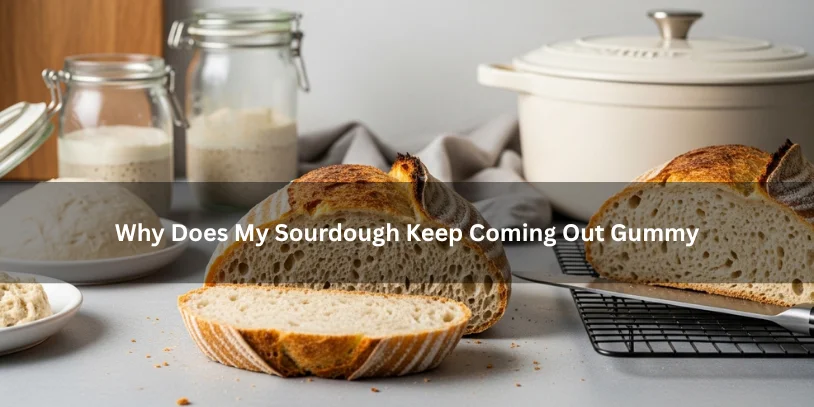
If your sourdough looks beautiful on the outside but turns sticky, wet, dense, or rubbery inside, you are dealing with one of the most frustrating bread problems a home baker can face.
A gummy sourdough crumb is usually caused by one or more of these issues: underbaking, underfermentation, too much hydration, a weak or young starter, or slicing the loaf before it has fully cooled.
The tricky part is that gummy sourdough rarely comes from just one dramatic mistake. More often, it comes from a chain of smaller problems. A dough can be slightly underproofed, slightly too wet, and slightly underbaked all at once. The crust may still look deep brown and impressive, which makes the crumb even more confusing.
The good news is that gummy sourdough is usually fixable once you know how to read the signs.
What “Gummy” Actually Means in Sourdough
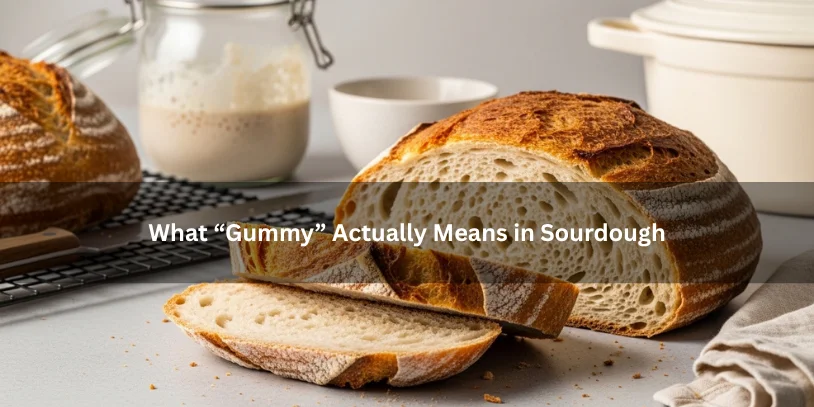
Not every moist loaf is gummy.
A good sourdough crumb can be moist, soft, and even a little custardy without being a failure. True gumminess usually feels sticky on the knife, slightly shiny inside, and unpleasantly tacky when you chew it. It may compress when sliced instead of cutting cleanly.
That is different from a loaf with:
- a moist but set crumb
- an open crumb with gelatinized walls
- a slightly tender whole wheat texture
- a rye loaf that naturally feels closer-textured
If your bread feels wet, rubbery, or dense enough that it seems underdone, then you likely have a real process issue to fix.
The Fast Answer: Why Sourdough Turns Gummy
In most cases, gummy sourdough happens because the crumb never fully set.
That usually points to one of these:
- the loaf was underbaked
- the dough was underfermented
- the hydration was too high for the flour
- the starter was too weak
- the loaf was cut too early
- the flour blend, especially whole wheat or rye, needed different handling
Start Here: Symptom-to-Cause Table
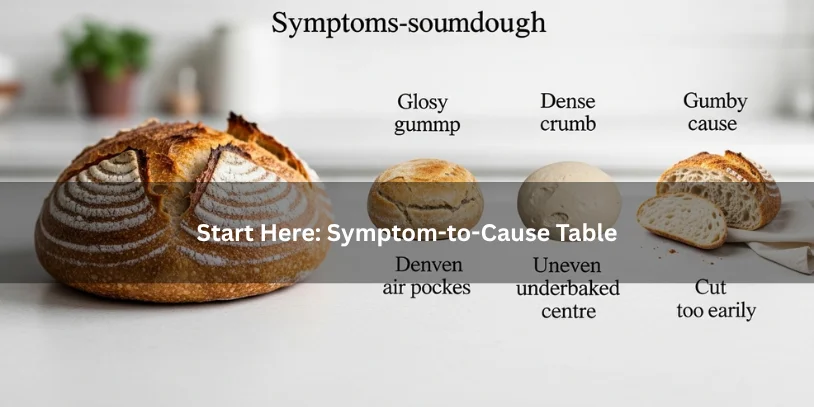
| Symptom | Most Likely Cause | What to Change First |
|---|---|---|
| Dark crust but sticky center | Underbaked loaf | Bake longer, especially uncovered |
| Dense and gummy crumb | Underfermented dough | Extend bulk fermentation |
| Very wet dough that spreads | Hydration too high | Reduce water slightly |
| Sticky only when sliced warm | Cut too soon | Cool longer before slicing |
| Flat loaf with tacky crumb | Overproofed or weak structure | Tighten proof and shaping |
| Whole grain loaf stays slightly tacky | Flour type and absorption | Adjust hydration and bake time |
This is the best place to begin. Don’t change five things at once. Identify the strongest clue, then correct one variable at a time.
The Most Common Cause: Underbaking
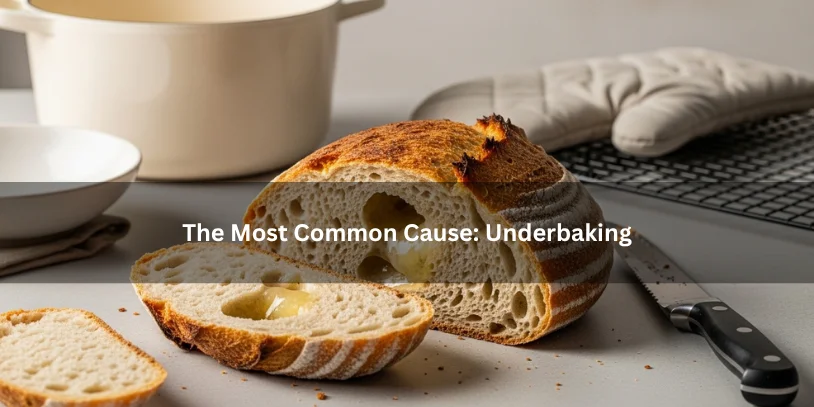
A loaf can look fully baked on the outside and still be underbaked inside.
This happens often with sourdough because the crust colors faster than the interior sets. A Dutch oven traps steam well in the early stage of baking, which is great for oven spring, but the loaf still needs enough uncovered time afterward for the crumb to dry and finish baking.
Signs your sourdough may be underbaked
- sticky knife when slicing
- shiny interior
- heavy feel for its size
- soft or damp bottom crust
- gumminess concentrated in the center
What to do
Use internal temperature as one check, not your only check. Many bakers look for the loaf to land roughly in the 200–210°F range, with 205–210°F often being a useful target for lean sourdough.
Also look at the full picture:
- Is the loaf light for its size?
- Does the bottom sound hollow-ish when tapped?
- Did it get enough uncovered baking time?
- Did it cool fully before slicing?
A dark crust alone is not enough evidence that the loaf is done.
Underfermentation: The Cause Many Bakers Miss
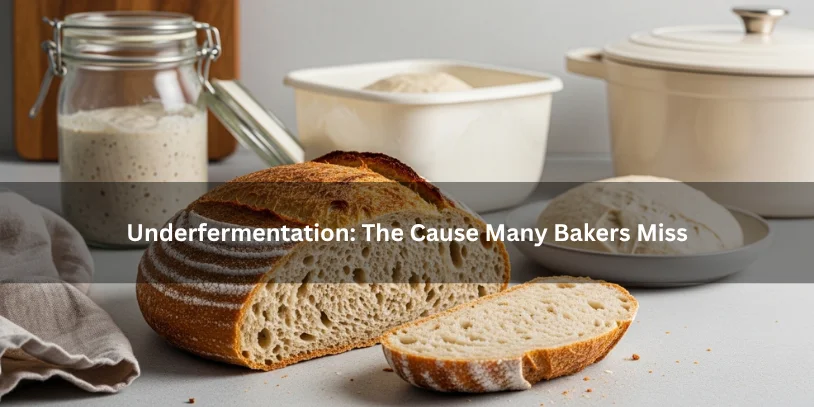
If your dough did not ferment long enough during bulk fermentation, the crumb can stay dense, damp, and gummy even if the loaf spent enough time in the oven.
This is where many bakers get confused. They see gumminess and assume “too much water,” when the real issue is often that the dough never developed enough gas, acidity, and strength.
Signs of underfermented sourdough
- dense loaf
- small, uneven holes
- weak oven spring
- tight lower crumb
- heavy interior with a sticky feel
What underfermentation usually comes from
- starter not fully ripe
- dough temperature too cool
- room temperature too low
- bulk fermentation ended too early
- relying only on the clock instead of the dough
Bulk fermentation is not a fixed number of hours. It changes with room temperature, dough temperature, starter strength, and flour choice. A dough in a cool kitchen may need much longer than one in a warm kitchen.
Weak or Young Starter Problems
A weak sourdough starter can create bread that looks close to right but bakes up gummy, especially if the loaf never fully develops structure.
If your starter is sluggish, too acidic, recently revived, or used before peak activity, it may not provide enough fermentation power.
Signs your starter may be part of the problem
- it rises slowly
- it does not reliably double
- it peaks weakly
- dough takes forever to bulk
- results are inconsistent from bake to bake
A ripe starter should show strong lift, visible bubbles, and predictable timing. If your starter is still young or unstable, the loaf may end up underfermented even when the recipe timing looks correct on paper.
Too Much Hydration for Your Flour
High hydration dough is often praised because it can create a more open crumb, but that advice backfires for many home bakers.
If your flour cannot handle the water level, or if the dough strength is not developed enough, the loaf can turn slack, spread too much, and bake into a gummy interior.
Signs hydration may be too high
- dough stays loose after folds
- shaping feels messy and weak
- loaf spreads instead of rising upward
- crumb feels wet even when fermentation seems decent
Why flour matters
Not all flour performs the same. Bread flour, all-purpose flour, whole wheat flour, and rye flour absorb water differently. Flour strength also varies by country and brand, so a formula that works well in one kitchen may come out gummy in another.
This is one reason global sourdough advice can feel inconsistent. Your room temperature, humidity, elevation, and local flour all change the result.
Whole Wheat and Rye Need Different Expectations
Whole wheat flour and rye flour behave differently from white bread flour.
Whole wheat brings bran and germ into the dough, which can interrupt gluten development and change water absorption. Rye is even more unique. Its structure depends less on gluten and more on other compounds, including pentosans, so the crumb can feel denser or slightly tackier by nature.
That does not mean all rye or whole grain bread should be gummy. It means the formula often needs:
- lower or more carefully managed hydration
- longer bake time
- longer cooling
- more realistic crumb expectations
If you are baking with a high percentage of whole wheat or rye, compare your loaf to the right standard, not a white-flour open crumb loaf.
Cutting Too Soon Can Ruin the Crumb
This is one of the most common mistakes, especially when the loaf smells incredible and the crust is crackling on the cooling rack.
Sourdough continues to settle after it comes out of the oven. Steam inside the loaf needs time to redistribute and escape. If you slice too early, the crumb can seem gummy even if the loaf was otherwise baked fairly well.
Wait before slicing
As a general rule:
- small loaves need at least a couple of hours
- larger loaves often benefit from 3–4 hours
- high-hydration or whole grain loaves may need even longer
If steam is still rushing out when you cut into the loaf, you cut too early.
Underproofed vs Overproofed vs Just Too Wet
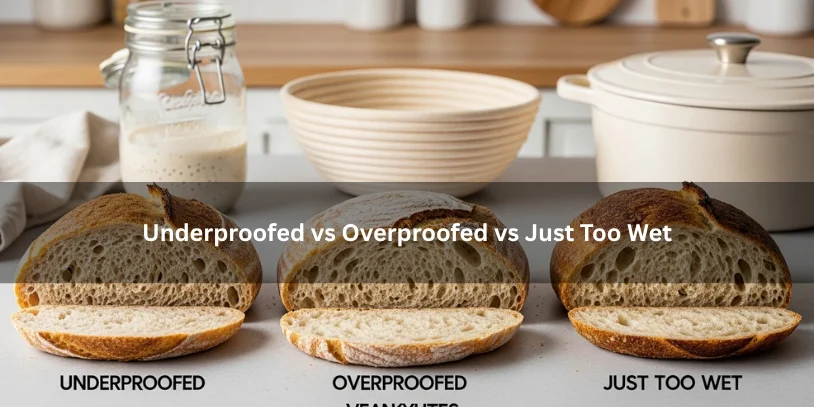
This is where many bakers get stuck.
Underproofed sourdough
Usually gives:
- dense crumb
- gummy texture
- uneven holes
- thick or compressed lower section
Overproofed sourdough
Usually gives:
- weak structure
- flatter loaf
- reduced oven spring
- crumb that may be tacky, compressed, or oddly fragile
Overhydrated dough
Usually gives:
- very slack handling
- spreading during shaping or baking
- wet-looking crumb
- difficult scoring and weak loaf shape
The reason this gets confusing is that these can overlap. A loaf can be both slightly underproofed and slightly overhydrated.
A Practical Troubleshooting Sequence
If your sourdough keeps coming out gummy, use this order the next time you bake.
1. Check the bake first
Before changing the whole formula, ask:
- Did I bake it long enough?
- Did I give it enough uncovered time?
- Does my oven run cool?
- Was the internal temperature in the proper range?
2. Check cooling time
Ask:
- Did I slice it while warm?
- Was the crumb still steaming?
- Did the loaf fully rest on a cooling rack?
3. Check fermentation
Ask:
- Was my starter fully active?
- Did bulk fermentation really finish?
- Did the dough look airy and lighter before shaping?
4. Check hydration and flour
Ask:
- Am I using too much water for this flour?
- Did I switch flour brands?
- Am I using a lot of whole wheat or rye?
5. Check what changed
If you previously baked good loaves and now you keep getting gummy ones, the real question is often not “what is sourdough?” but “what changed?”
Look at:
- flour brand
- kitchen temperature
- hydration percentage
- bake time
- starter feeding routine
- proofing time
- oven behavior
That one question often solves the mystery faster than chasing every possible cause.
Tools That Help Most
You do not need a huge setup, but a few tools make diagnosis easier:
- digital kitchen scale
- instant-read thermometer
- oven thermometer
- Dutch oven or baking vessel
- proofing container
- banneton
- cooling rack
A thermometer is especially useful when you are trying to separate underbaking from fermentation issues.
Best Practices for a Better Crumb
Use your starter at peak or close to it
A ripe levain or active starter gives you better fermentation and more predictable structure.
Watch the dough, not just the clock
Fermentation timelines change with climate, room temperature, and dough temperature.
Match hydration to your flour and skill level
There is no prize for using more water than your flour can hold.
Give the loaf enough uncovered baking time
The second stage of the bake is what helps dry and set the crumb.
Cool fully before slicing
Even a well-baked loaf can seem gummy when cut too early.
Keep notes
Track:
- flour used
- hydration percentage
- room temperature
- dough temperature
- bulk time
- final proof
- internal temperature
- cooling time
That makes repeat failures much easier to solve.
If Your Sourdough Is Already Gummy, Can You Save It?
You usually cannot turn a fully baked gummy loaf into a perfect loaf after the fact, but you may still be able to use it.
Options include:
- toasting slices
- making croutons
- turning it into breadcrumbs
- rewarming slices in the oven to improve texture somewhat
If the center is truly raw or doughy, it is better treated as a baking failure than pretending it is ideal sourdough texture.
FAQs
Why is my sourdough gummy even after cooling?
If it is still gummy after full cooling, the most likely causes are underbaking, underfermentation, or too much hydration for your flour and process.
Is gummy sourdough underbaked or underproofed?
It can be either. Underbaked loaves are often sticky in the center with a dark crust, while underproofed loaves tend to be denser with weaker oven spring and a tighter crumb.
Can overproofing make sourdough gummy?
Yes. An overproofed loaf can lose structure and bake into a compressed, tacky crumb, especially if the dough was already weak.
Does cutting sourdough too early make it gummy?
Yes. Cutting too soon interrupts the crumb-setting process and can make the interior seem sticky or wet even if the loaf was otherwise close to done.
What internal temperature should sourdough be?
A common doneness range for lean sourdough is about 200–210°F, with many bakers aiming around 205–210°F.
Can high hydration cause a gummy crumb?
Yes, especially if your flour is not strong enough or the dough is underdeveloped. High hydration is helpful only when the dough has enough strength and the bake is long enough.
Can a weak starter make sourdough gummy?
Absolutely. A weak or young starter can lead to poor fermentation, which often produces a dense and gummy crumb.
Is rye sourdough supposed to be gummy?
Rye bread can feel denser and slightly tackier than white sourdough, but it should not feel raw or unpleasantly wet. Rye formulas need different handling and expectations.
Why is my crumb shiny but not fully raw?
A shiny crumb can mean excess moisture, slight underbaking, or a very gelatinized interior. Look at the full picture: texture, slice quality, density, and how well the loaf cooled.
Conclusion
If your sourdough keeps coming out gummy, the answer is usually not one single dramatic mistake. It is more often a combination of underbaking, underfermentation, excess hydration, weak starter performance, or slicing too early.
Start with the highest-impact fixes first: bake a little longer, cool the loaf completely, make sure your starter is strong, and stop chasing ultra-high hydration until your process is consistent. Once you learn to read the crumb and connect it to fermentation, flour, and bake time, gummy sourdough becomes much easier to prevent.