
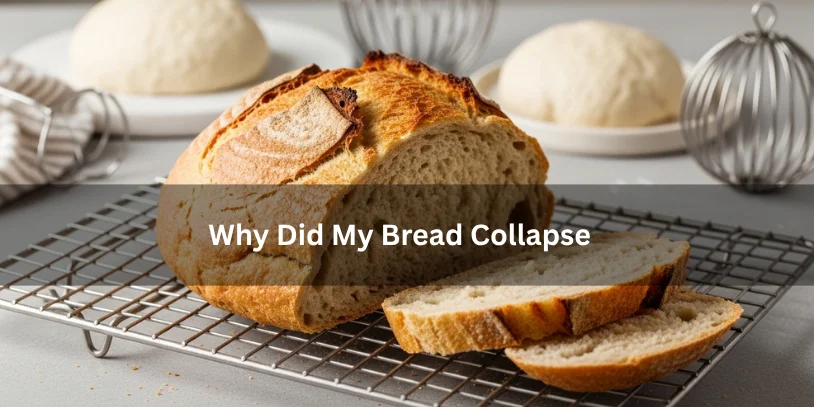
Bread usually collapses because the dough produced more gas than its structure could hold. In most cases, the real issue is overproofing, weak gluten development, too much hydration, underbaking, or poor oven heat.
If your loaf looked beautiful and then sank, you are not alone. This is one of the most common bread problems for beginners and experienced bakers alike. The good news is that a collapsed loaf is usually very fixable once you identify when it failed.
That timing matters more than most people think. A loaf that collapses before baking points to a different problem than one that sinks in the oven or caves in after cooling.
What a Collapsed Loaf Actually Means
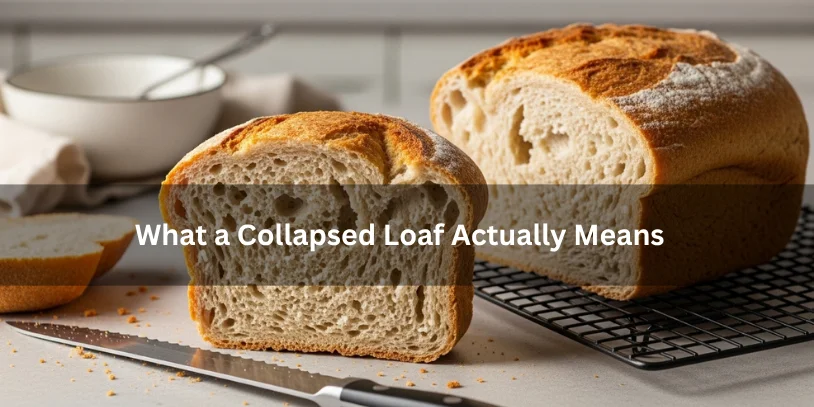
A collapsed loaf is a structure problem.
As bread dough ferments, yeast or a sourdough starter creates gas. The dough traps that gas through a gluten network or, in gluten-free bread, through binders and starch structure. During oven spring, that gas expands even more. If the dough strength, shaping tension, crust setting, or crumb setting is not strong enough, the loaf falls.
A slight shrink while cooling is normal. A true collapse is different. That usually looks like:
- a sunken center
- collapsed sides
- a flat top after a high rise
- a gummy center under a pale crust
- a loaf that rose, then deflated when scored or transferred
Diagnose It by Timing First
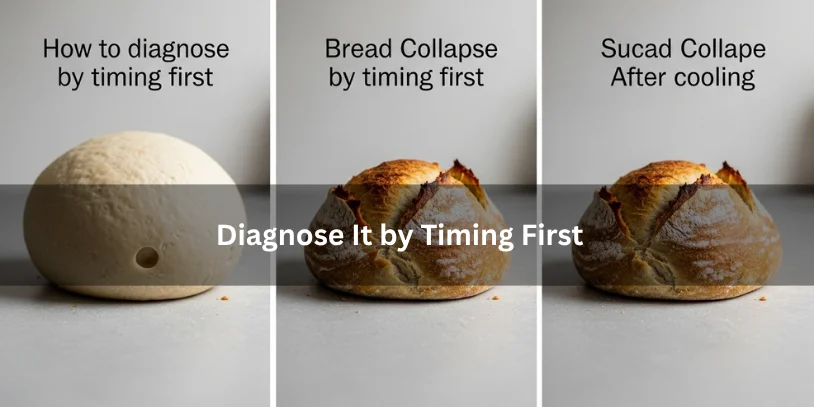
Before changing your recipe, figure out the stage where the failure happened.
| When it collapsed | Most likely cause | What it usually means |
|---|---|---|
| Before baking | Overproofing, weak shaping, too much liquid | Dough was already too fragile |
| In the oven | Overproofing, weak gluten, low oven temperature | Oven spring exceeded dough strength |
| After baking or while cooling | Underbaking, unset crumb, slicing too soon | Exterior looked done, inside was not fully set |
| During scoring or transfer | Overproofing, sticky handling, weak surface tension | Dough could not tolerate movement |
This one step saves a lot of wasted troubleshooting.
The Most Common Reasons Bread Collapses
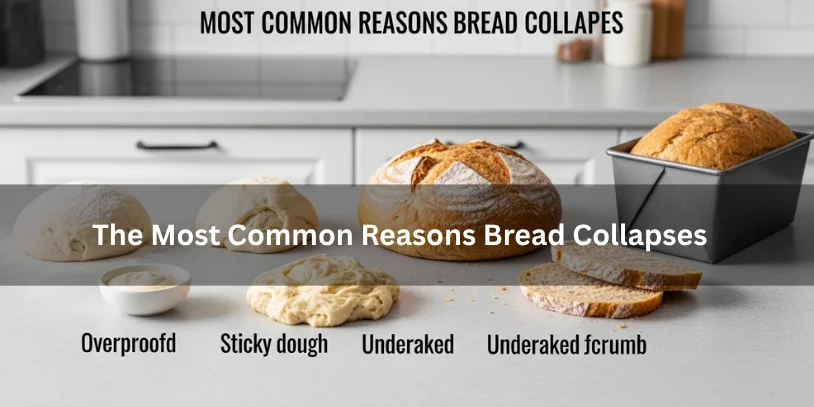
1. Overproofing
This is the most likely cause in many home kitchens.
When dough stays in proofing too long, the gluten network stretches too far. It may still look full of life, but it has already lost strength. Then one of two things happens: it collapses in the oven, or it deflates when touched, scored, or moved.
Signs of overproofed dough
- the dough feels very airy but weak
- a poke test leaves a dent that barely springs back
- the surface looks swollen and delicate
- the dough deflates easily during scoring
2. Weak gluten development
Bread needs strength as well as rise.
If you did not knead enough, skipped stretch-and-folds, used weak flour, or handled a high-hydration dough without enough structure building, the loaf may rise but not hold shape. Gas retention becomes poor, oven spring becomes unstable, and the crumb collapses.
This is especially common with:
- all-purpose flour used in a bread formula that expects bread flour
- whole wheat dough without enough development
- dough mixed too briefly
- very wet dough with no folds
3. Too much hydration or too much liquid
A slack dough can look promising during fermentation and still fail later.
Hydration affects crumb openness, extensibility, and shaping. But if the dough is too wet for the flour strength, pan size, or your handling skill, it may spread instead of rising upward. It can also create a gummy center and collapsed top.
This problem often shows up as:
- sticky dough that never firms up
- weak shaping tension
- large irregular holes near the top
- a loaf that spreads wide instead of rising tall
4. Underbaking
A loaf can look done on the outside and still be unstable inside.
This is why some breads collapse after baking rather than during it. The crust forms, the loaf browns, and it even sounds hollow enough. But the crumb has not fully set. As steam escapes during cooling, the loaf sinks.
This is common in:
- large sandwich loaves
- enriched doughs
- bread machine loaves
- gluten-free breads
- high-hydration doughs
5. Low or inaccurate oven temperature
If your oven runs cool, the dough keeps expanding before the structure sets.
That delayed crust and crumb setting can cause the loaf to rise too long in the oven and then collapse. If the oven is far hotter than expected, you can get the opposite problem: the crust sets too fast while the center stays underdeveloped.
An oven thermometer is one of the simplest tools for solving this.
6. Poor shaping and weak surface tension
A well-fermented dough still needs support.
During shaping, you build outer tension so the loaf can rise upward rather than outward. If the dough is loosely shaped, has weak seam control, or is poorly moulded for the loaf pan or banneton, collapse becomes much more likely.
You will often notice:
- flat shoulders
- spreading during final proof
- no real lift during oven spring
- collapse after scoring
7. Too much yeast
More yeast does not equal better bread.
Too much yeast can make dough rise too quickly. Fast fermentation often outruns dough maturity. The dough gets volume before it gets strength, which means it looks ready sooner than it truly is.
8. Flour choice or flour strength mismatch
Bread flour, all-purpose flour, whole wheat flour, and rye all behave differently.
If the recipe expects a stronger gluten network than your flour can provide, the loaf may not hold its structure. Whole grain doughs and rye doughs also behave differently from white wheat doughs, so they need different expectations and handling.
9. Scoring, transfer, or rough handling
A fully proofed loaf can be fragile.
If the dough sticks to the peel, drops slightly during transfer, or gets scored too deeply, it can deflate before it even starts baking. This is especially common with sourdough, high-hydration dough, and dough that was already close to overproofed.
10. Bread machine cycle mismatch
Bread machine bread often sinks in the middle for a few repeat reasons:
- too much liquid
- too much yeast
- wrong flour
- cycle mismatch
- lid opened during the wrong stage
- incorrect pan size or recipe scaling
Bread machine dough is less forgiving because the mixing, proofing, and baking cycle is fixed.
11. Gluten-free structure failure
Gluten-free bread is different.
Without a traditional gluten network, structure depends on starches, gums, psyllium, eggs, and moisture balance. That means a gluten-free loaf can collapse even when proofing looks fine. The issue is often in the binder system or bake setting rather than classic overproofing alone.
12. Cutting too soon
Fresh bread needs cooling time.
If you slice while the crumb is still steaming, the interior can compress and seem collapsed even if the loaf baked reasonably well. Cooling on a rack matters more than many bakers realize.
Overproofed vs Underproofed Bread
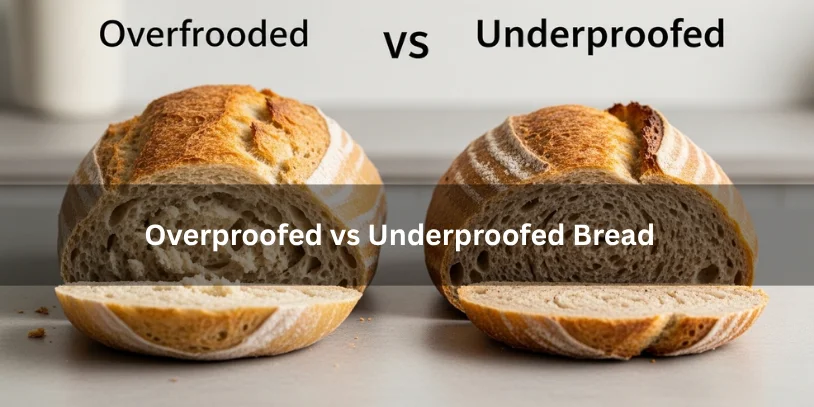
| Problem | What it looks like | What happens in baking |
|---|---|---|
| Underproofed | Tight dough, springs back fast, dense feel | Can split badly, rise unevenly, stay dense |
| Overproofed | Puffy, fragile, dent stays in place | Often rises then falls, or collapses when moved |
People mix these up all the time.
If you are asking, “Is my bread overproofed or underproofed?” start with touch, structure, and how easily the dough deflates.
Why Bread Can Collapse After Cooling
This deserves its own explanation because it is not always the same problem as a loaf collapsing in the oven.
When bread sinks after cooling, the issue is often:
- underbaking
- too much internal moisture
- crumb not fully set
- slicing too soon
- very high hydration without enough bake time
That is different from a loaf that collapses during oven spring, which more often points to overproofing, weak dough strength, or low oven heat.
Why Did My Bread Collapse After Baking?
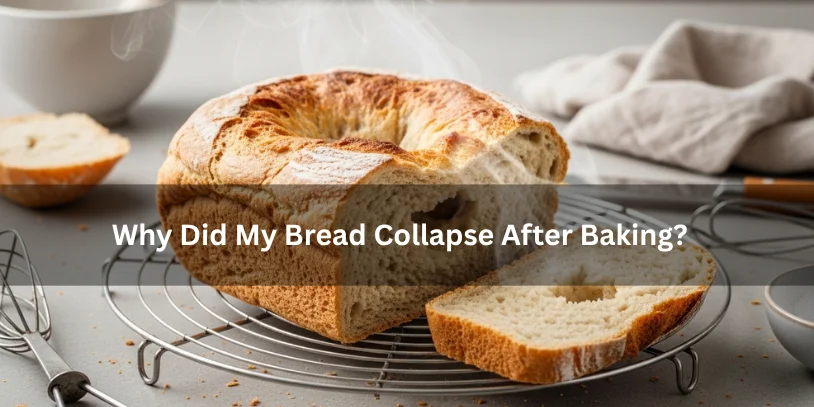
If your bread looked fine in the oven but sank after you took it out, the most likely issue is that the loaf was not fully set inside. In most cases, this happens because of underbaking, too much internal moisture, or cutting the bread too soon while the crumb is still unstable.
A loaf can appear finished on the outside and still be weak in the center. The crust may look golden, but the inner crumb has not fully baked enough to hold its shape as steam escapes during cooling. Once that steam leaves, the loaf shrinks, wrinkles, or caves in.
Most common reasons bread collapses after baking
- Underbaking: the center stayed too wet or gummy
- Too much hydration: the dough held more moisture than the structure could support
- Large loaf size: bigger loaves often need more baking time than expected
- Weak crumb structure: not enough gluten development or support
- Cutting too early: slicing while hot releases steam too fast and compresses the loaf
Signs this is your issue
- the top sinks while cooling on the rack
- the loaf feels light but soft in the center
- the crumb looks gummy or slightly wet
- the crust wrinkles after baking
- the bread looks baked outside but feels underdone inside
How to prevent it next time
reduce hydration slightly if your dough is consistently too wet
bake the loaf a little longer
check for a fully set center before removing it
avoid judging doneness by color alone
let the bread cool completely on a rack
What to Fix First on Your Next Bake
Do not change five things at once. Fix one variable first.
Start here, in this order:
- Shorten final proof slightly if the dough looked fragile or over-risen.
- Improve dough development with better kneading or stretch-and-folds.
- Check oven accuracy with an oven thermometer.
- Bake longer if the center seemed gummy or the loaf sank while cooling.
- Reduce hydration slightly if the dough was very slack or sticky.
- Shape tighter to build better surface tension.
That one-variable approach helps you actually learn what changed the result.
A Practical Bread Collapse Checklist
If it collapsed before baking
Focus on:
- overproofing
- weak shaping tension
- too much hydration
- sticky transfer from peel or banneton
If it collapsed in the oven
Focus on:
- overproofing
- weak gluten network
- weak flour
- too much yeast
- low oven temperature
If it collapsed after baking
Focus on:
- underbaking
- gummy center
- cooling too briefly
- loaf pan too large for the dough
- too much moisture retained inside
Bread-Type Specific Troubleshooting
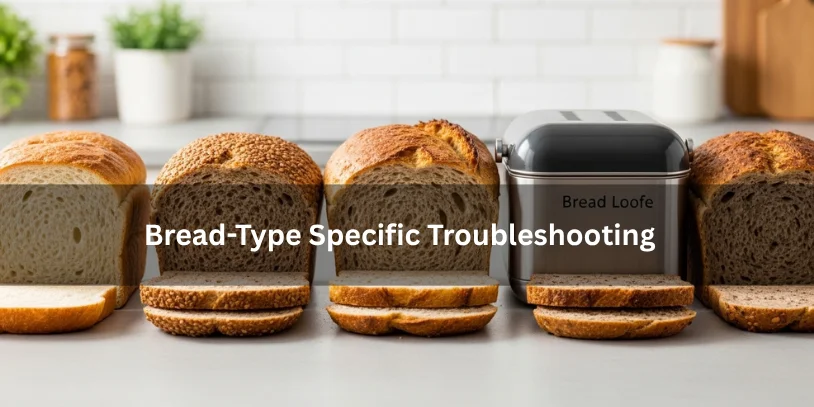
Yeast bread
Standard yeast bread usually collapses because of proofing, shaping, flour strength, or baking time. This is the easiest type to fix because the structure rules are fairly consistent.
Sourdough
A sourdough loaf can collapse from overproofing, weak levain activity, poor shaping tension, excess hydration, or rough scoring. Sourdough also tends to expose transfer mistakes more clearly because a well-proofed loaf can still be very delicate.
Whole wheat bread
Whole wheat dough absorbs water differently and usually feels heavier. If you expect the same oven spring as white bread, you may think the loaf failed when it is really just a denser style. True collapse, though, often points to weak structure or overproofing.
Enriched bread
Milk breads, buttery loaves, and richer sandwich doughs need more support than people expect. Fat and sugar make dough softer, which means kneading and baking need extra attention.
Bread machine bread
Bread machine loaves often fail because the formula does not match the machine cycle. Watch liquid levels, yeast amount, flour type, and loaf size.
Gluten-free bread
Gluten-free collapse has a different mechanic. The problem is often not “weak gluten” but weak binder balance, excess moisture, or insufficient bake structure. Treat gluten-free bread as a separate system, not a direct copy of wheat bread.
Helpful Tools That Actually Matter
You do not need a bakery setup, but a few tools make diagnosis easier:
- digital scale for better formula accuracy
- oven thermometer to verify real heat
- thermometer probe for checking doneness
- straight-sided container for proof-volume tracking
- banneton or loaf pan that supports the dough properly
- cooling rack so the loaf can set without trapping steam
For professional or high-volume baking, dough temperature, humidity, pan temperature, and proofing box conditions matter even more.
Can You Still Eat Collapsed Bread?
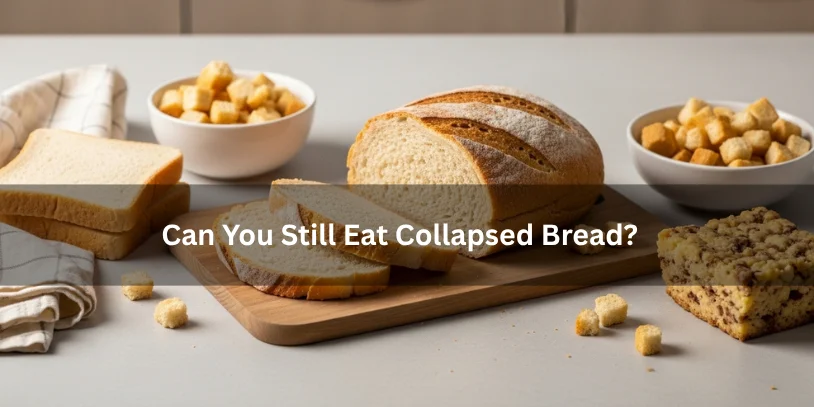
Usually, yes.
If the bread is fully baked, collapse is mostly a texture problem, not a safety issue. If it is underbaked and gummy, you may be able to return it to the oven if you catch it early. If the loaf tastes good but looks ugly, it can still work for:
- toast
- croutons
- breadcrumbs
- bread pudding
- grilled sandwiches
So no, a collapsed loaf is not automatically wasted.
The Best Way to Prevent Bread Collapse
If you want one simple framework, use this:
Watch the dough, not just the clock
Room temperature, dough temperature, humidity, flour type, and starter strength all affect timing.
Build strength before chasing height
A tall rise means nothing if the dough strength is weak.
Proof until ready, not until huge
A loaf that looks dramatic is not always a loaf that is ready.
Bake until set, not just browned
Crust color can mislead you.
Cool before slicing
Let the crumb finish setting.
FAQs
Why did my bread rise and then fall?
It usually rose faster than its structure could support. Overproofing is the most common cause, but weak gluten, too much liquid, and low oven temperature can also do it.
Why did my bread collapse after baking?
That usually points to underbaking or an unset crumb. The outside looked done, but the inside did not fully finish setting before cooling.
Why did my bread collapse in the oven?
A collapse in the oven usually means the dough was already too weak by the time oven spring happened. Overproofing, weak flour, poor shaping, or low oven heat are common causes.
Why did my sourdough collapse when I scored it?
Sourdough often collapses during scoring when it is overproofed, overhydrated, or lacking surface tension. Sticky transfer and deep scoring can make the problem worse.
Why does bread machine bread sink in the middle?
Bread machine loaves often sink because of too much liquid, too much yeast, wrong flour, or a recipe that does not match the machine’s cycle and loaf size.
Can too much yeast make bread collapse?
Yes. Too much yeast can push the dough to rise too quickly before the gluten network is ready to support that growth.
Can low oven temperature cause bread collapse?
Yes. If the oven runs cool, the loaf can expand for too long before the crust and crumb set, which increases the risk of collapse.
Is collapsed bread safe to eat?
Usually yes, if it is fully baked. Collapse is most often a texture and quality issue. If the center is raw or very gummy, it needs more baking or may not be pleasant to eat.
How do I know if my bread is overproofed?
The dough often feels fragile, looks very puffy, and fails the poke test by leaving a dent that barely springs back. It may also deflate easily when touched or scored.
Why does gluten-free bread collapse more easily?
Because it does not rely on a traditional gluten network. Its structure depends on moisture balance, starches, gums, psyllium, eggs, and bake setting, so small formula changes can have a big effect.
Conclusion
If your bread collapsed, the loaf was not “bad luck.” It was feedback.
Start by asking when it failed: before baking, in the oven, after cooling, or during scoring. Then work backward from the most likely causes: overproofing, weak dough strength, too much hydration, low oven temperature, or underbaking.
For your next loaf, change just one thing first. In most cases, the smartest first move is to shorten proofing slightly, strengthen the dough more, and verify that the loaf is fully baked before cooling. That one small adjustment often turns a sunken loaf into a solid, well-shaped one.