
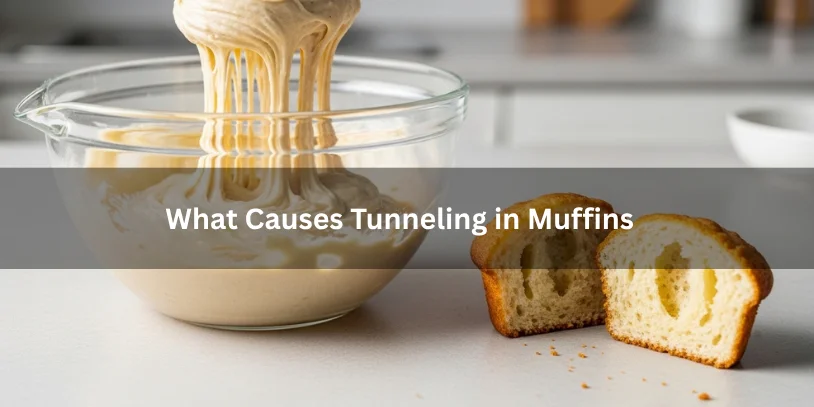
Tunneling in muffins means long, narrow holes form inside the crumb instead of a soft, even texture. It usually happens when the batter is overmixed, which develops too much gluten and changes how the muffin rises.
Other things like too much baking powder, thick batter, uneven dry ingredients, or an oven that runs too hot can make tunneling worse. This guide explains what tunneling means, what causes it, and how to stop it in your next batch.
What Is Tunneling in Baking?
In baking, tunneling means long air channels or holes form inside the crumb instead of a fine, even texture. It is most common in muffins and quick breads, where gentle mixing matters a lot.
Tunneling usually points to a batter that became too strong, too uneven, or too aggressively handled before baking. That is why it is closely linked to overmixing, excess leavening, and heavy batter texture.
What Is Tunneling in Muffins?
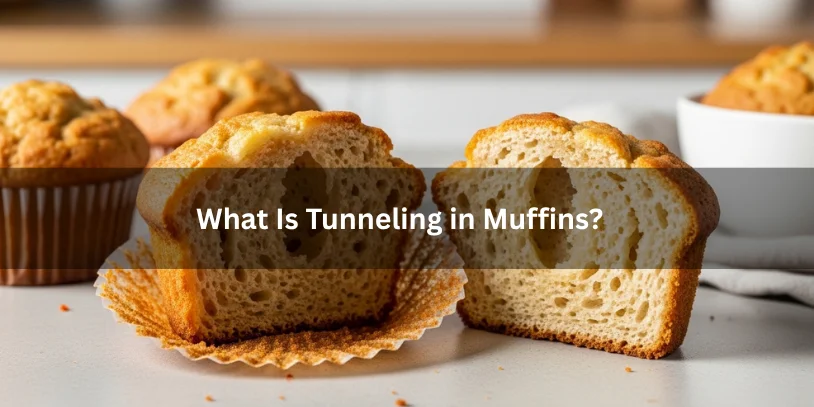
Tunneling means long vertical holes or stretched air pockets inside muffins. Instead of a soft, even crumb, the interior shows channels, coarse pockets, or hollow-looking streaks.
This often comes with other signs too:
- tough or chewy texture
- pointy or peaked muffin tops
- rough interior crumb
- large holes instead of fine, even air cells
- muffins that feel more bread-like than tender
In simple terms, the batter structure became too strong or too uneven, so the gases produced during baking pushed through the crumb and left tunnels behind.
Why Tunneling Happens So Easily in Muffins
Muffins are a type of quick bread. Unlike yeast bread, quick breads are supposed to be mixed gently so they stay tender.
That is why bakers use the muffin method:
- Mix dry ingredients in one bowl
- Mix wet ingredients in another
- Combine them briefly
- Stop as soon as the flour is mostly moistened
This method works because it limits gluten development. Once flour meets liquid, gluten starts forming. The more you stir, whisk, or beat, the stronger that gluten network becomes.
A stronger batter may sound helpful, but in muffins it usually creates the opposite of what you want. Instead of soft crumb texture, you get tunnels, chewiness, and uneven air pockets.
The Main Cause of Tunneling: Overmixing
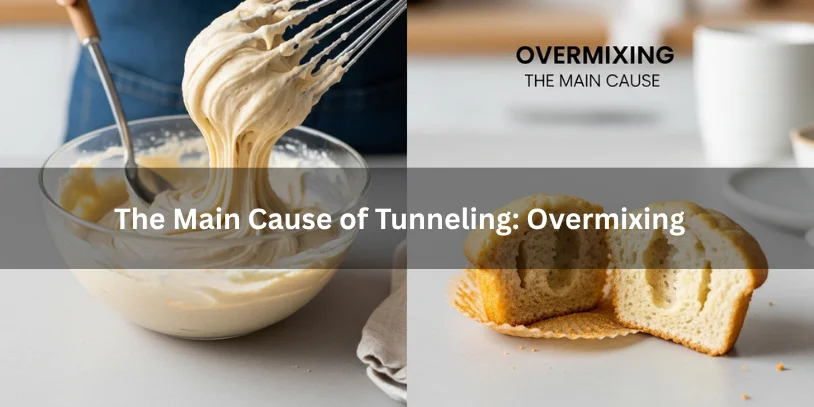
If you only remember one thing, remember this: most muffin tunneling starts with overmixing.
When batter is overmixed:
- gluten develops too much
- the batter becomes smoother and more elastic
- gas expansion during baking gets channeled into long air tunnels
- the crumb becomes tougher and less tender
This is why recipe writers often say to mix until just combined. That phrase is not filler. It is the difference between tender muffins and tunnel-filled muffins.
What overmixed batter usually looks like
Before baking, overmixed muffin batter often looks:
- too smooth
- glossy or slightly stretchy
- thinner or runnier than expected
- very uniform, with no visible lumps
Many beginners think smooth batter means success. For muffins, that is usually a warning sign.
What properly mixed batter looks like
Good muffin batter is usually:
- slightly lumpy
- thick but scoopable
- not glossy
- not fully smooth
- lightly folded, not beaten
If your muffin batter is lumpy, that is often a good thing.
Other Causes of Tunneling in Muffins
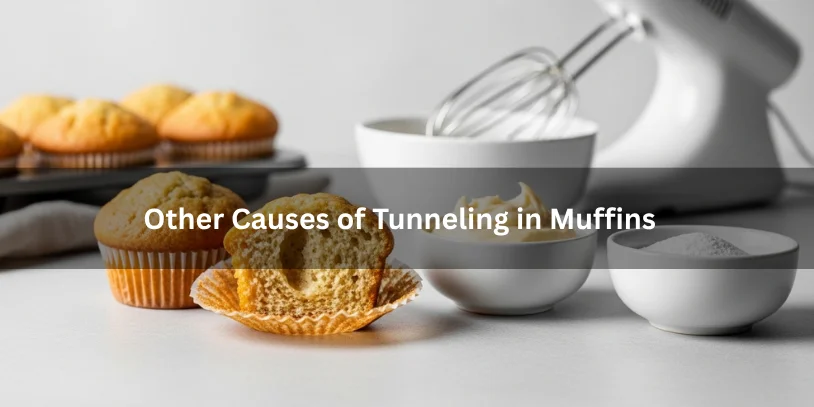
Overmixing is the main cause, but it is not the only one. Several other factors can push the crumb in the wrong direction.
1. Too Much Baking Powder or Baking Soda
Chemical leavening produces gas. If you use too much baking powder or baking soda, the batter can create more gas than the structure can support evenly.
That can lead to:
- larger holes
- coarse crumb
- tunnels
- sharp rise followed by unstable texture
This often happens when measuring is inaccurate or when a recipe is poorly balanced.
2. Uneven Distribution of Dry Ingredients
If baking powder, baking soda, or salt is not mixed well into the flour, some parts of the batter may react more strongly than others.
That causes uneven gas release, which can create localized tunnels and air pockets. This is why whisking or sifting dry ingredients matters more than many home bakers realize.
3. Batter That Is Too Thick
Very thick batter can make it harder for bubbles to distribute evenly. Instead of rising gently through a balanced crumb, the gases may push through in narrow paths and leave channels behind.
A thick batter can happen when:
- too much flour is added
- flour is packed into the measuring cup
- there is not enough liquid
- too many mix-ins are added
- whole-grain flour is used without adjusting hydration
4. Oven Temperature That Is Too High
A hot oven can set the outer structure of the muffin too quickly. While the inside is still expanding, gases may force their way through the crumb in uneven channels.
This can make tunneling worse and may also lead to:
- dark tops
- peaked muffin crowns
- rough crumb
- uneven internal texture
5. Aggressive Mixing Tools
A whisk, hand mixer, or stand mixer can quickly take muffin batter too far. A spoon or spatula gives you better control.
Muffin batter does not need to be whipped or beaten. It needs to be folded gently.
Symptom, Likely Cause, and Fix
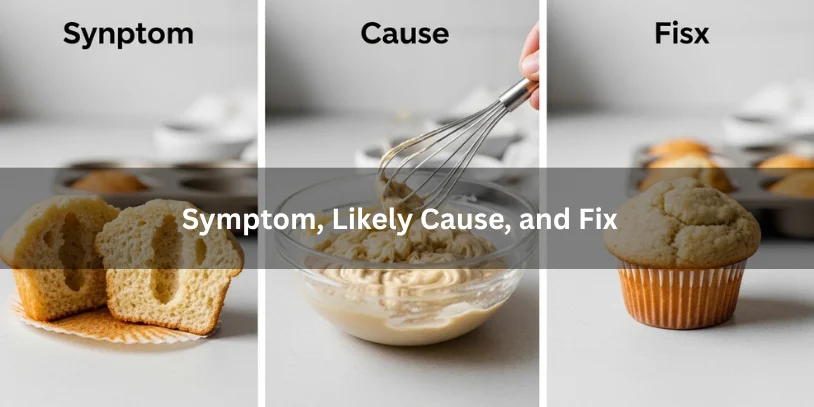
| Symptom | Likely Cause | Best Fix |
|---|---|---|
| Long holes inside muffins | Overmixing | Fold gently and stop while batter is still lumpy |
| Chewy or bread-like texture | Too much gluten development | Reduce mixing time and avoid electric mixers |
| Pointy muffin tops | Overmixed batter or overly hot oven | Mix less and verify oven temperature |
| Large random air pockets | Too much leavening or uneven dry mixing | Measure carefully and whisk dry ingredients well |
| Dense but holey crumb | Thick batter or poor ingredient balance | Check flour amount and liquid ratio |
| Smooth, glossy batter | Overmixed or overaerated batter | Use a spoon/spatula and mix only until combined |
Why Lumpy Batter Is Correct for Muffins
One of the biggest reasons home bakers get tunneling is that they try to make muffin batter look like cake batter.
That is a mistake.
Cake and cupcake batters are often smoother because they are built around different mixing methods and texture goals. Muffins are different. A little roughness in the batter helps keep the crumb tender.
So if you are asking, should muffin batter be lumpy or smooth?
The answer is: slightly lumpy.
Not dry. Not floury. Not unmixed. But definitely not silky smooth.
Why Tall, Pointy Muffin Tops Matter
Many people think a high dome always means a great muffin. Not necessarily.
If your muffins come out tall, peaked, and chewy inside, that often points to one of these issues:
- overmixing
- too much leavening
- oven temperature that is too high
A rounded, well-risen muffin with an even crumb is usually a better sign than a dramatic pointy top with tunnels inside.
Tunneling vs. Underbaking
These two problems can look similar at first, but they are different.
Tunneling
- long internal holes
- coarse crumb
- chewy or tough texture
- often linked to overmixing
Underbaking
- gummy center
- wet or raw-looking batter
- collapsed middle
- sticky crumb rather than tunnel-like channels
If your muffin has holes but still seems baked through, tunneling is more likely than underbaking.
How to Prevent Tunneling in Muffins
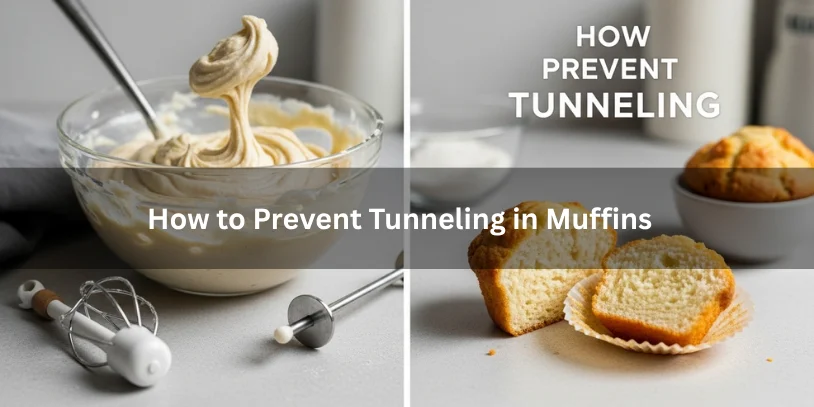
Here is the simplest prevention system for better muffins every time.
1. Measure Carefully
Use the correct amount of flour and leavening. Spoon flour into the measuring cup and level it off instead of packing it down. Measure baking powder and baking soda precisely.
2. Mix Dry Ingredients Thoroughly
Whisk flour, baking powder, baking soda, salt, and spices together before adding wet ingredients. This helps distribute chemical leavening evenly.
3. Mix Wet Ingredients Separately
Combine eggs, milk, buttermilk, sour cream, oil, or melted butter in a separate bowl first. This gives you a more even batter without extra stirring later.
4. Combine Wet and Dry Gently
Pour wet into dry and fold with a spoon or spatula. Avoid beating. Avoid chasing a smooth texture.
5. Stop Early
Once the flour is mostly moistened, stop. A few lumps are normal. This is the part many people miss.
6. Check Oven Temperature
Use an oven thermometer if possible. Oven calibration matters. If your oven runs hot, you may be setting the structure too quickly and exaggerating crumb defects.
Muffin Troubleshooting Framework
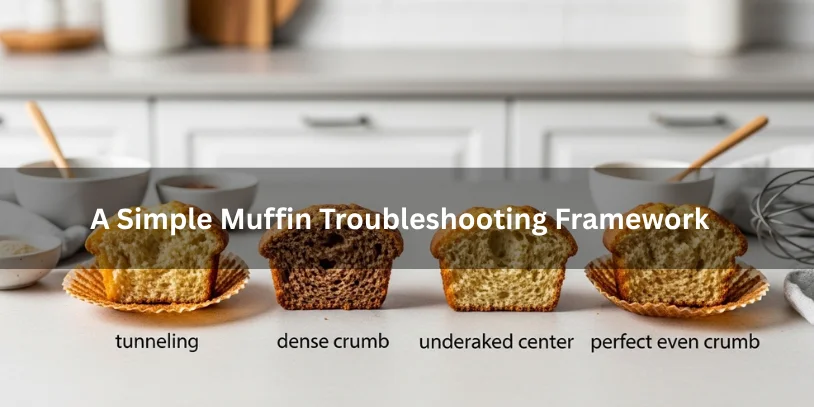
If your muffins have tunnels, use this quick diagnosis.
If the batter was smooth before baking
The likely cause is overmixing.
If the muffins rose dramatically and felt coarse inside
The likely cause may be too much baking powder or too much baking soda.
If the batter was very stiff and hard to scoop
The likely cause may be too much flour or not enough liquid.
If the tops browned too fast
The likely cause may be a hot oven.
If you used a mixer
The likely cause is often a mixing issue first.
This kind of one-variable-at-a-time thinking is how pros troubleshoot baking problems. Do not change five things at once. Change one factor, bake again, then compare.
What Your Batter Before Baking Can Tell You
Your batter gives you clues before the oven ever gets involved.
If the batter is lumpy and thick
That is often correct for muffins.
If the batter is smooth and glossy
You may have developed too much gluten already.
If the batter is stiff and heavy
Check flour measurement and liquid balance.
If the batter feels foamy or overaerated
You may have mixed too aggressively.
Learning to read batter texture is one of the most useful baking skills because it lets you fix the problem before baking, not after.
Can Recipe Design Cause Tunneling Too?
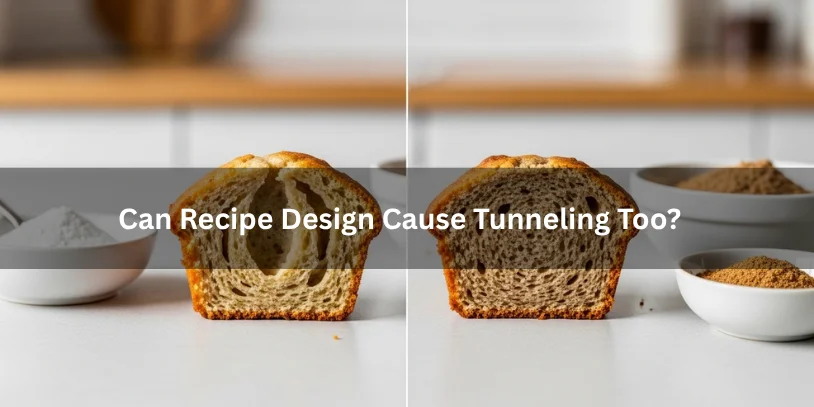
Yes, sometimes the issue is not only technique. Some recipes are simply unbalanced.
A muffin recipe can be more tunnel-prone if it has:
- too much leavening
- too much flour
- too little fat
- too little moisture
- too many dry add-ins
- weak instructions that tell you to mix too much
That said, even a decent recipe can fail if the mixing method is wrong. In most real-world cases, technique is still the first place to look.
Is Tunneling Only a Muffin Problem?
No. Muffins are one of the most common places people notice tunneling, but the same problem can show up in other quick breads and sometimes in cake-style batters too.
The main reason is usually the same: the batter was mixed too much, the leavening was off, or the structure set unevenly during baking. Muffins just make the problem easier to spot because their crumb is supposed to stay tender and slightly coarse, not chewy or full of long holes.
Best Practices for Tender Muffins
If you want a softer, more even crumb, keep these habits in mind:
- use the muffin method every time
- mix with a spoon or spatula, not a mixer
- leave some lumps in the batter
- measure baking powder and baking soda carefully
- avoid overworking the batter when adding fruit, nuts, or chocolate chips
- check your oven temperature if problems keep repeating
- use room-temperature ingredients when a recipe suggests them for more even blending
Small technique changes make a big difference in quick breads.
The Fastest Fix for Your Next Batch
If your last batch had tunnels and you want one fast improvement, do this:
Mix less than you think you should.
That one change solves the biggest cause of tunneling in muffins. If the problem remains, check leavening, batter thickness, and oven temperature next.
FAQs
1. What causes tunneling in muffins?
The most common cause is overmixing the batter. Overmixing develops too much gluten, which creates long air channels instead of a soft, even crumb.
2. What is tunneling in baking?
Tunneling in baking means long holes or air channels form inside the crumb instead of a fine, even texture. It is especially common in muffins and quick breads.
3. Should muffin batter be lumpy or smooth?
Muffin batter should usually be slightly lumpy. A very smooth, glossy batter often means it has been mixed too much.
4. Can overmixing make muffins chewy?
Yes. Overmixing can make muffins chewy, tougher, and more bread-like because of extra gluten development.
5. Can too much baking powder cause tunnels in muffins?
Yes. Too much baking powder or baking soda can create excess gas, which can lead to large holes, coarse crumb, and tunneling.
6. Why are my muffins tall and pointy on top?
Tall, pointy muffin tops often suggest overmixing, too much leavening, or an oven that is too hot.
7. Are tunnels in muffins the same as underbaking?
No. Tunneling creates long holes and a coarse crumb, while underbaking usually leaves the center gummy, wet, or raw-looking.
8. Can tunneling happen even if I mix by hand?
Yes. Hand mixing is safer than using a mixer, but you can still overmix if you keep stirring too long.
9. What is the muffin method?
The muffin method means mixing dry ingredients separately from wet ingredients, then combining them briefly with gentle folding.
10. What is the easiest way to prevent tunneling in muffins?
The easiest fix is to mix less than you think you should. Stop as soon as the batter is mostly combined and still slightly lumpy.
Conclusion
Tunneling in muffins usually comes down to one main issue: the batter was mixed too much for a tender quick bread. Once gluten develops too far, the gases created during baking push through the crumb and leave long holes instead of a soft, even texture.
The easiest fix is simple: mix less, leave some lumps, and stop early. If tunneling still happens, check your leavening, batter thickness, and oven temperature one at a time. That approach gives you the best chance of getting muffins with a lighter crumb and a much better interior.