
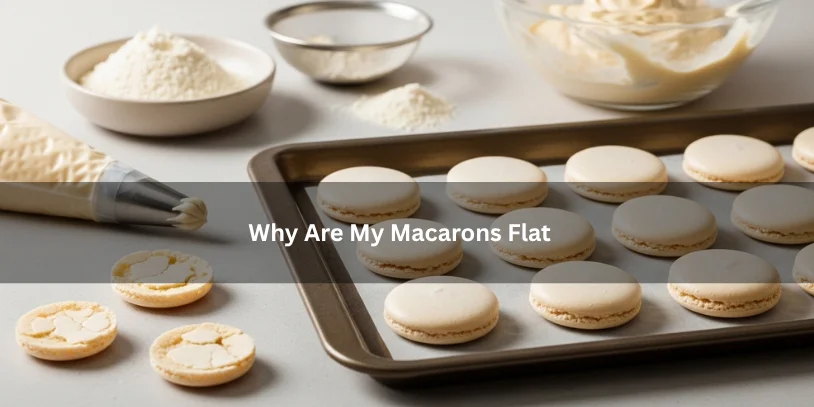
Flat macarons usually mean one thing: your shells lost structure somewhere between the meringue, the macaronage, the resting stage, and the bake. If they spread too much, rise weakly, or come out with no feet, the problem is almost never random.
The tricky part is that flat macarons can come from more than one mistake. A weak meringue, overmixed batter, too much moisture, high humidity, poor resting, or the wrong oven temperature can all lead to the same disappointing result. That is why guessing rarely works.
This guide is built to help you identify the exact cause based on what your shells look like, when the problem showed up, and what to change first on your next batch.
What flat macarons actually mean
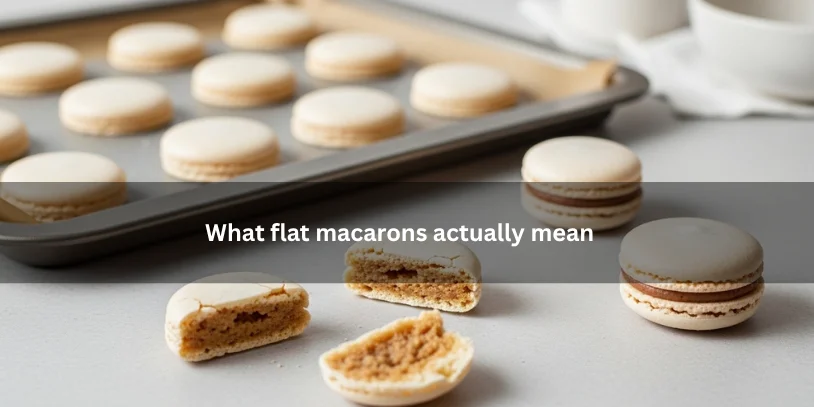
A proper macaron shell should have a smooth top, a gentle dome, and defined ruffled feet. It should not spread out like a puddle or bake into a thin, fragile disc.
When macarons turn flat, it usually means the batter could not hold air or expand correctly in the oven. That can happen because:
- the meringue was not whipped to proper stiff peaks
- the batter was overmixed during macaronage
- the batter was too wet
- the shells did not dry enough before baking
- the oven ran too hot or too cool
- the shells were underbaked
If you have ever wondered whether macarons and macaroons are the same thing, they are not. Macarons are delicate sandwich cookies made with almond flour and meringue. Macaroons are usually coconut-based cookies. Flat macarons are a shell-structure problem, not a naming problem.
The fastest way to diagnose flat macarons
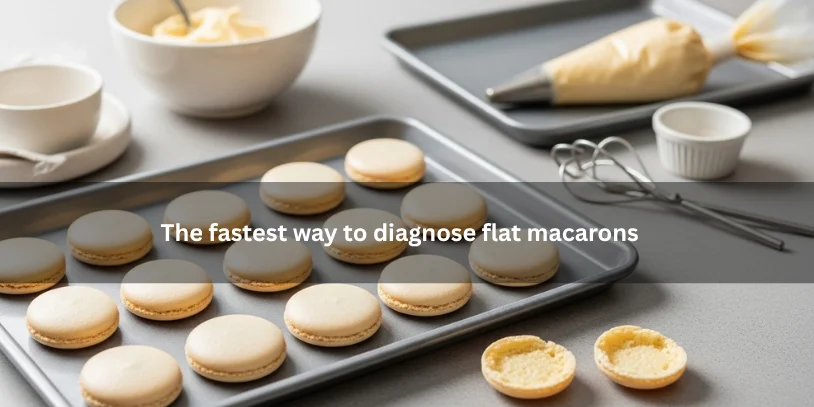
Before changing your whole recipe, match the symptom first.
| What you see | Most likely cause | What to change first |
|---|---|---|
| Flat shells with no feet | Weak meringue, overmixed batter, poor rest, low oven | Check meringue and folding first |
| Flat and wrinkly shells | Low oven, underbaking, unstable batter | Adjust bake temperature and time |
| Flat and crispy shells | Overmixed batter, oven too hot | Stop macaronage earlier and lower heat slightly |
| Flat shells that spread after piping | Batter too thin, too much moisture | Fold less and reduce liquid inputs |
| Flat shells only on humid days | High humidity, shells not drying properly | Extend drying and control moisture |
| First tray okay, second tray bad | Reheated tray, hot spots, oven inconsistency | Cool trays fully and bake one tray at a time |
That table alone can save you from wasting another batch of almond flour.
The most common reasons your macarons are flat
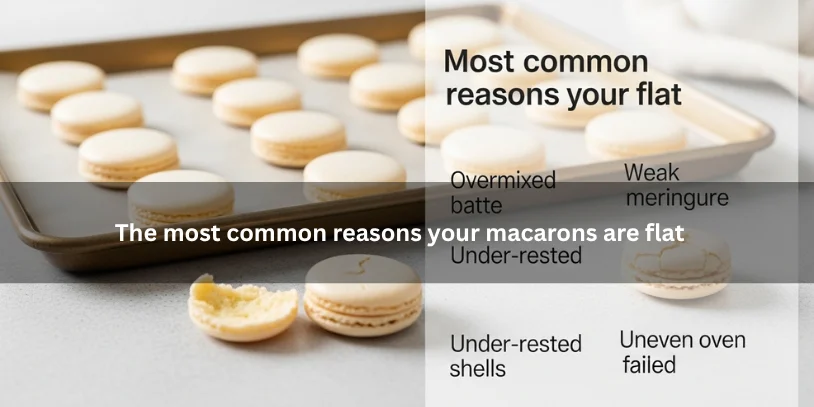
1. Your batter was overmixed during macaronage
This is one of the biggest reasons macarons go flat.
Macaronage is the folding stage where the almond flour and powdered sugar are incorporated into the meringue. If you keep folding too long, the batter loses air and becomes too loose. Instead of holding shape and rising with feet, it spreads out.
Signs of overmixed batter:
- it runs off the spatula too fast
- it melts back into itself almost instantly
- piped circles spread wide before you even tap the tray
- baked shells look flat, thin, or flat and crispy
A good batter should flow slowly, like lava. If you do the ribbon stage test, the ribbon should settle back gradually, not disappear instantly.
2. Your meringue was too weak
Macaron lift starts with the meringue. If the egg whites were under-whipped, the batter has no real backbone.
Weak meringue often leads to:
- flat shells
- no feet
- fragile tops
- uneven rise
- hollow shells in some cases
You want stiff peaks, not soft peaks. When you lift the whisk, the peak should stand upright with only a slight curl. If it slumps over, keep going. Also make sure your bowl is completely grease-free. Even a little fat or yolk can stop egg whites from whipping properly.
3. Your batter was too wet
Wet batter is not always caused by overmixing. Sometimes the recipe or add-ins bring in too much moisture from the start.
Common causes include:
- liquid food coloring
- too much extract
- humid ingredients
- poorly measured egg whites
- unstable meringue that breaks down quickly
For shell color, gel food coloring or powdered food coloring is much safer than liquid coloring. If your shells are flat and also slow to dry, excess moisture is a strong suspect.
4. Your kitchen was too humid
Macarons are famously sensitive to humidity, and for good reason. The shells need to form a dry skin before baking. In a humid climate, on a rainy day, or in a damp kitchen, that skin may take far longer to form.
If the tops stay tacky, the shells may not rise properly. You may end up with flat shells, no feet, cracked shells, or wrinkly shells.
This is why a recipe that worked perfectly last week can suddenly fail today. Sometimes the problem is not the formula. It is the weather.
5. You baked them before the shells were ready
Resting matters, but not because of a fixed timer. What matters is whether the shell surface is dry to the touch.
Some kitchens need 25 to 40 minutes. Others need 60 to 90 minutes. In very humid conditions, it can take even longer.
If you bake too early, the shells may:
- rise unevenly
- crack
- form weak feet
- flatten out
- wrinkle on top
Instead of asking, “How long should macarons rest?” ask, “Are they dry enough to bake?”
6. Your oven temperature was too low
A low oven can leave macarons flat, weak, and underdeveloped. The tops may wrinkle, the feet may stay tiny, and the shells may feel delicate even after baking.
This happens because the shell does not get the burst of heat it needs to lift and set properly. If your macarons are flat and soft rather than flat and crisp, low heat is one of the first things to check.
7. Your oven temperature was too high
Too much heat can cause a different version of failure. The shell may set too fast on the outside, lose balance, or deflate as trapped air shifts. Some bakers also end up with flat crispy shells when the oven is too aggressive.
Hot ovens can also create confusing results:
- one tray looks fine
- the next tray spreads
- the shells tilt
- the tops brown before the centers are ready
That is why an oven thermometer is not optional for serious macaron baking. The oven dial is often lying to you.
8. Your shells were underbaked
Some flat macarons are not really a mixing problem. They are a finish problem.
If the tops look set but the shells still wobble, stick to the mat, or collapse after cooling, they may be underbaked. Underbaked shells can look deceptively close to done, which makes this issue easy to miss.
9. Your tray, mat, or airflow is affecting the bake
Equipment matters more than people think.
Dark baking trays retain more heat than lighter silver trays. A convection fan can push shells in one direction or dry them unevenly. A reheated sheet tray can alter how the second batch behaves. Even parchment paper and silicone mat setups can change the way heat transfers underneath the shells.
If your first tray behaves differently from your second tray, or one side of the tray always rises differently, look beyond the recipe.
What to change first on your next batch
Do not change six things at once. That usually makes troubleshooting harder.
Use this order instead:
- Check the meringue
Make sure you are reaching stiff peaks and using a clean, dry bowl. - Watch the macaronage
Stop folding earlier than you think. Batter should flow, but not run. - Remove excess moisture
Use gel food coloring, measure carefully, and keep add-ins minimal. - Rest until dry
Ignore the timer. Bake only when the tops are matte and dry to the touch. - Verify oven temperature
Use an oven thermometer and learn whether your oven runs hot, cool, or uneven. - Bake one tray at a time
This helps with consistency, especially if your oven has hot spots.
That single-variable testing framework is the smartest way to improve quickly.
Flat + wrinkly, flat + no feet, flat + hollow: what each combo usually means
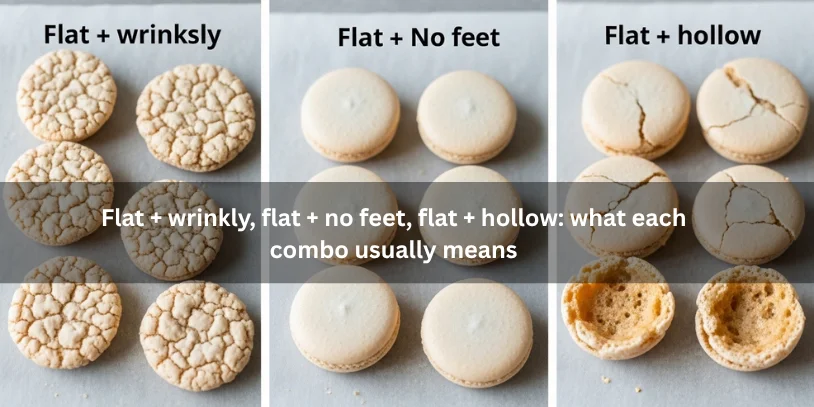
Flat and wrinkly
This usually points to low oven temperature, underbaking, or batter instability. The shell starts to form but never gets enough lift or structure.
Flat and no feet
This often means weak meringue, overmixed batter, poor drying, or a wet batter. If the feet never form at all, start with the meringue and macaronage.
Flat and hollow
This can happen when the shell structure sets unevenly or the interior dries out badly. Oven imbalance, unstable meringue, and overmixing can all contribute.
Flat and crispy
This usually points to overmixed batter or excessive oven heat. These shells often look thin and dry rather than soft and fragile.
Can flat macaron batter be saved?
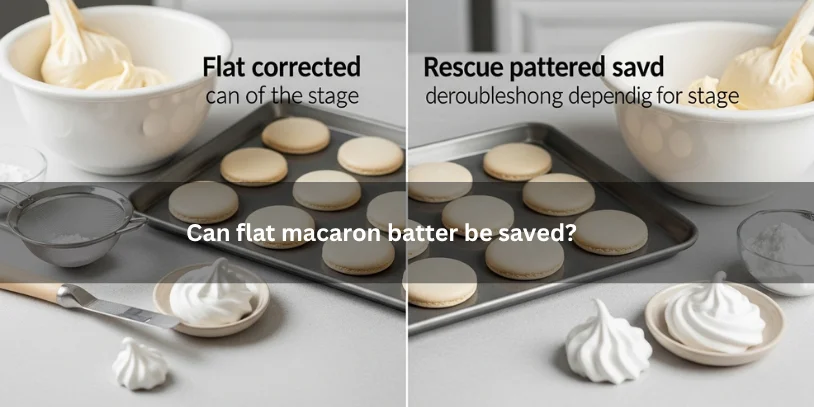
Sometimes yes, sometimes no.
| Situation | Salvageable? | Best move |
|---|---|---|
| Meringue slightly under-whipped before folding | Sometimes | Rewhip only if still separate and not fully combined |
| Batter clearly overmixed and runny | Usually no | Start over |
| Shells piped but still too wet to bake | Sometimes | Let them rest longer in a drier room |
| Oven clearly miscalibrated | Yes | Adjust temperature and rebake next batch with thermometer |
| Second tray failed due to warm pan | Yes | Cool tray completely before reusing |
There is no graceful fix for badly overmixed batter. Once the structure is gone, it is gone.
Tools that matter more than expensive gear
You do not need a luxury kitchen setup, but a few tools make a big difference:
- kitchen scale for precise measurement
- oven thermometer for real temperature control
- light-colored baking trays for steadier heat
- parchment paper or silicone mat for consistent bottoms
- stand mixer or hand mixer strong enough to reach stable stiff peaks
- dehumidifier or air conditioning if you bake in a humid climate
If you are deciding where to spend money, buy the oven thermometer first. It solves more mystery problems than almost any other tool.
Parchment or silicone mat?
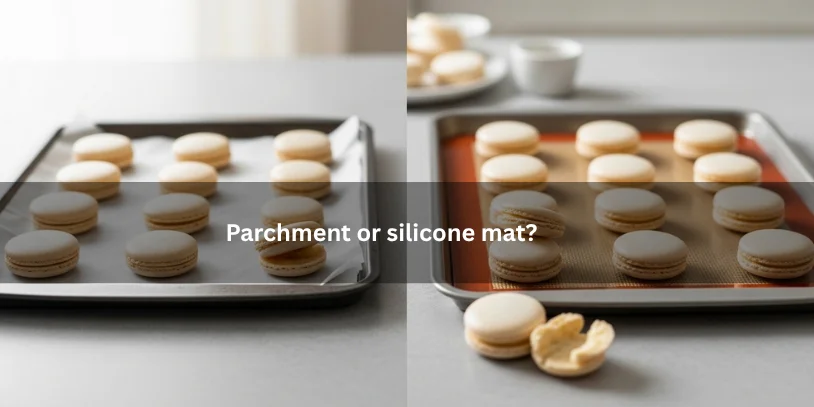
Both can work, but consistency matters more than brand loyalty.
Parchment paper may give a slightly different bottom texture and heat transfer than a silicone mat. Silicone mats can slow bottom heat slightly in some ovens. If you keep switching between them while also changing recipes, it becomes much harder to troubleshoot.
Pick one setup and test it consistently for a few batches before changing variables.
French, Swiss, or Italian meringue: does the method matter?
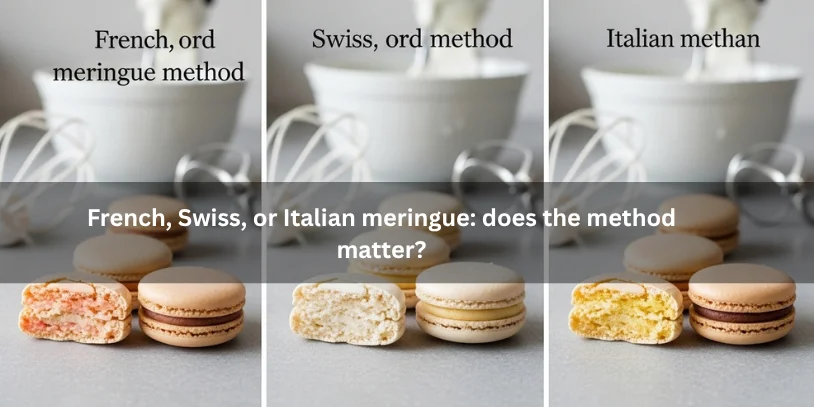
Yes, but not in the way many people think.
- French meringue is common, accessible, and popular with home bakers, but it can be less forgiving.
- Swiss meringue tends to be more stable because the sugar is dissolved over heat before whipping.
- Italian meringue is also very stable, but more technical and equipment-heavy.
If you keep getting flat macarons despite careful technique, switching methods can help. But most flat shells are still caused by execution problems, not the method alone.
Why visual cues beat fixed timing every time
Macarons punish blind timing.
A batter can reach ribbon stage sooner or later depending on your meringue strength. Shells can dry quickly in one kitchen and take forever in another. The bake can shift if your oven cycles unpredictably.
The best bakers rely on cues like:
- stiff peaks
- lava-like flow
- figure 8 test
- dry-to-the-touch shell
- stable feet
- shells that release cleanly after cooling
When you trust those cues more than the clock, your results get better.
FAQs
Why are my macarons flat and have no feet?
Usually because the batter was overmixed, the meringue was weak, the shells were too wet, or they did not dry enough before baking.
Can overmixing make macarons flat?
Yes. Overmixed batter loses air and spreads too much, which leads to flat macaron shells and weak or missing feet.
Can humidity make macarons flat?
Absolutely. High humidity makes it harder for the shells to form a dry skin, which can affect rise, feet, and surface texture.
How long should macarons rest before baking?
As long as needed for the tops to become dry to the touch. In one kitchen that may be 30 minutes. In another, it may be more than an hour.
Can too much food coloring flatten macarons?
Yes, especially if you use liquid food coloring. Extra moisture can weaken the batter and slow drying.
Is my oven too hot or too low?
If the shells are flat and soft, the oven may be too low. If they are flat and crispy or behave inconsistently from tray to tray, the oven may be too hot or uneven.
Can flat macarons still be filled?
Yes, if the shells are baked through and not too fragile. They may not look perfect, but they can still be used.
Why does one tray come out worse than the other?
Often because the tray was still warm, the oven has hot spots, or airflow changed during the second bake.
Should I use parchment or silicone for macarons?
Either can work. The bigger issue is staying consistent so you can actually judge what changes are helping.
Should I age egg whites?
Some bakers find aged egg whites helpful for meringue consistency, but they are not a magic fix. Good whipping technique and clean equipment matter more.
Conclusion
If you keep asking, “Why are my macarons flat?” the answer is usually hiding in one of four places: meringue strength, macaronage, moisture, or oven behavior. The shells are telling you what went wrong. You just need to read the signs correctly.
Start with the symptom, change one variable at a time, and focus on visual cues instead of rigid timing. Once you do that, flat macarons stop feeling random and start becoming one of the easiest macaron problems to fix.