
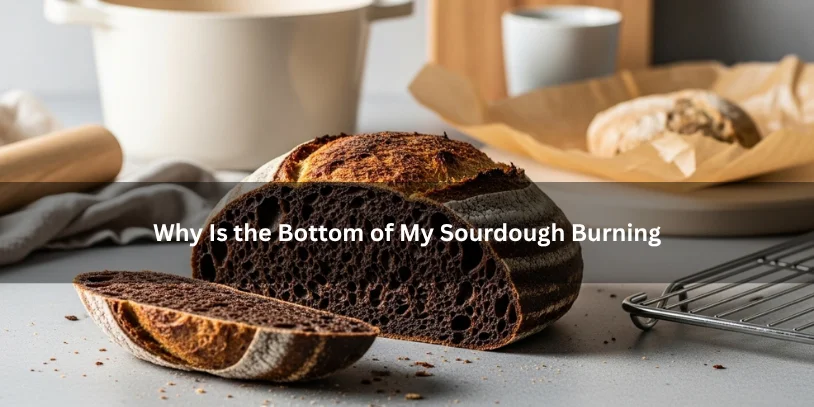
The bottom of sourdough usually burns because it is getting too much direct heat from the baking vessel or oven floor before the rest of the loaf finishes baking. In most home ovens, the main problem is not the dough itself. It is the way heat is being transferred.
That is why a loaf can look beautiful on top, spring well in the oven, and still come out with a black, thick, or bitter underside.
For home bakers, this problem most often shows up when baking in a Dutch oven, cast iron combo cooker, on a baking stone, or especially on a baking steel. A long preheat, low rack position, dark pot interior, or strong bottom heat can all make the issue worse.
What is actually happening inside the oven?
There are two main kinds of heat working on your bread:
- Conductive heat, which comes from direct contact with a hot surface
- Radiant heat, which comes from the hot air and heated surfaces around the loaf
When the bottom of sourdough burns, conductive heat is usually winning too hard.
Your loaf is sitting directly on a very hot surface such as cast iron, a baking stone, or a baking steel. That surface keeps transferring heat into the base faster than the crumb and top crust can finish baking evenly. The result is overbrowning, scorching, or a very thick hard bottom crust.
The most common reasons the bottom of sourdough burns
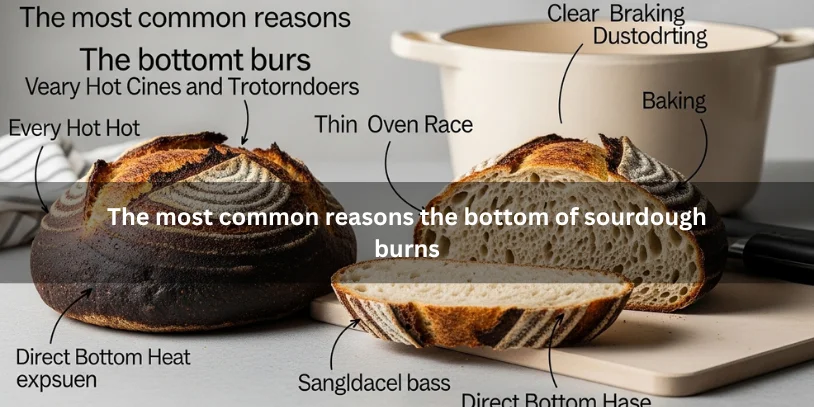
Here are the biggest causes to check first:
| Cause | What it does | Common result |
|---|---|---|
| Dutch oven or cast iron preheated too long | Stores intense bottom heat | Burnt underside |
| Rack too low in the oven | Places loaf closer to bottom heat source | Dark or black base |
| Baking steel used like a pizza setup | Transfers heat very aggressively | Fast scorching |
| Dark or black pot interior | Absorbs and radiates more heat | Faster bottom browning |
| Bake temperature too high | Crust darkens before center finishes | Tough, bitter base |
| Too much uncovered bake time | Continues browning after loaf is done | Overdark bottom |
| Flour, cornmeal, oats, or rice under loaf | Can burn during bake | Bitter burnt layer |
| Whole-grain or dense loaf | Needs longer bake time | Bottom burns before center is ready |
Quick diagnosis first
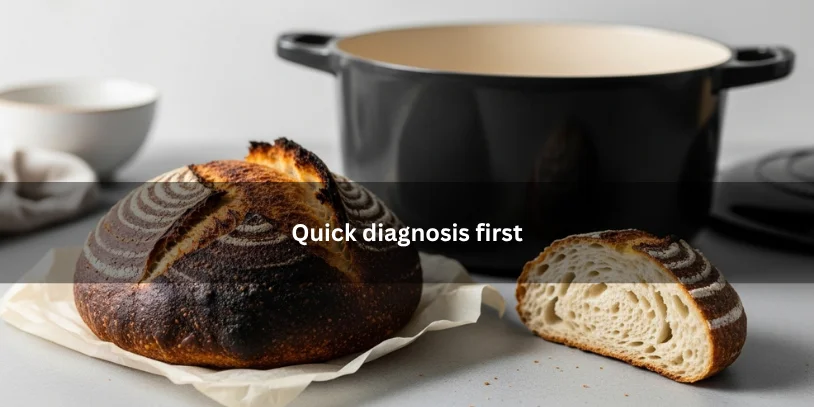
Before changing everything, match your loaf to the most likely cause.
If the bottom is burnt but the top looks good
The surface under the loaf is too hot. This usually points to a Dutch oven, cast iron base, baking steel, or low rack position.
If the bottom is burnt and the top is pale
Your loaf is getting too much bottom heat and not enough balanced overall heat. Raise the rack and consider adding a sheet pan buffer underneath.
If the bottom is very dark but not fully burnt
Your setup may be slightly too aggressive rather than completely wrong. A small temperature drop or shorter uncovered bake may fix it.
If it only happens with whole-grain or larger loaves
Those loaves often need more bake time, so the bottom stays in contact with high heat longer. That increases the risk of scorching even when your white sourdough turns out fine.
Dutch oven problems: the biggest trouble spot
A Dutch oven is great for oven spring and steam retention, but it is also the most common reason bakers end up with a burnt base.
Cast iron has high thermal mass. Once fully preheated, it holds a lot of heat. If your loaf sits directly on that blazing-hot bottom for most of the bake, the underside can darken too quickly.
This gets worse when:
- the pot is preheated for a long time
- the Dutch oven sits on a low rack
- the pot has a dark or black interior
- the Dutch oven is placed on top of a baking stone or baking steel
- the loaf stays in the pot for the entire bake even after it no longer needs that much bottom heat
A light-colored interior can sometimes be gentler than a dark interior, especially in enamel-coated cookware. Darker interiors tend to brown faster.
Baking stone vs baking steel
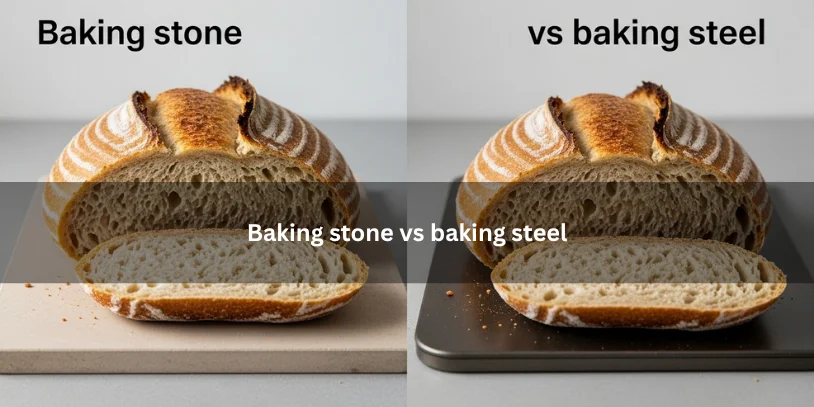
Many bakers assume a baking stone and a baking steel behave the same way. They do not.
Baking stone
A baking stone gives steady heat and can produce a nice crust, but it is generally more forgiving than steel.
Baking steel
A baking steel transfers heat much faster. That makes it fantastic for pizza, but it can be too aggressive for sourdough if used without adjustment.
If your sourdough bottom keeps burning on a steel, the steel may simply be delivering more bottom heat than bread needs.
What to change first
Do not overhaul your entire process at once. Change one variable first, then test again.
Here is the best order to troubleshoot:
1. Move the loaf higher
Bake on the middle rack instead of the lower rack. This is one of the fastest and most reliable fixes.
2. Put a sheet pan underneath
Place an empty sheet pan on the rack below your Dutch oven, loaf pan, stone, or steel. This acts as a heat shield and softens the harsh bottom heat.
3. Lower the baking temperature slightly
If you are baking very hot from start to finish, try reducing the temperature by about 10 to 20°C after loading the loaf.
4. Reduce direct contact heat
Use parchment paper, a double layer of parchment, or in some setups a foil disk barrier under the loaf. Some bakers also use a silicone sling or a trivet.
5. Shorten the most aggressive part of the bake
That may mean a slightly shorter covered phase, a shorter uncovered phase, or removing the loaf from the Dutch oven near the end to finish on the rack.
The best fixes by setup type
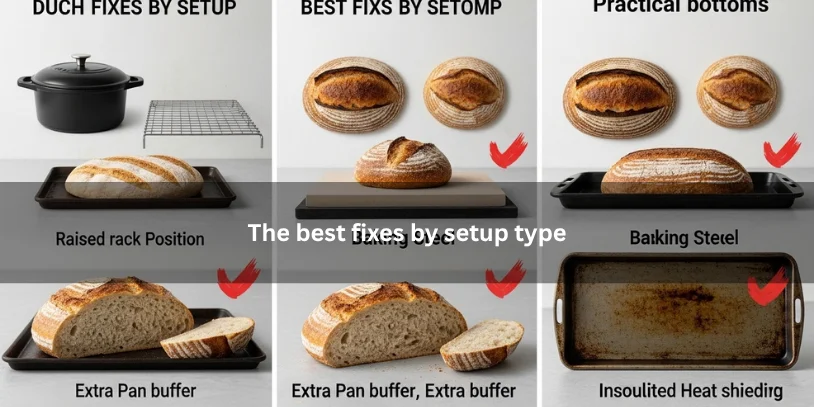
If you bake in a Dutch oven
Try this sequence:
- Move the Dutch oven to the middle rack
- Put a sheet pan on the rack below
- Use parchment paper under the loaf
- Lower the oven temperature slightly after loading
- If needed, remove the loaf from the Dutch oven near the end and finish directly on the oven rack
This is often enough to fix the problem without affecting oven spring too much.
If you bake on a baking stone
Try:
- moving the stone slightly higher
- checking whether the oven is running hotter than the dial says
- using parchment paper
- lowering temperature slightly if the underside darkens too fast
If you bake on a baking steel
Be more cautious, because steel is much more aggressive.
Try:
- raising the rack
- shortening the preheat a little
- dropping the temperature
- not placing a Dutch oven on top of the steel
- switching to a stone if the problem continues
If you bake in a loaf pan
Dark metal pans can intensify browning. A lighter pan can help.
Also check:
- rack position
- whether the pan is sitting too close to the oven floor
- whether the bake time is longer than needed
Parchment, foil, rice, cornmeal, oats, or trivet: what actually works?
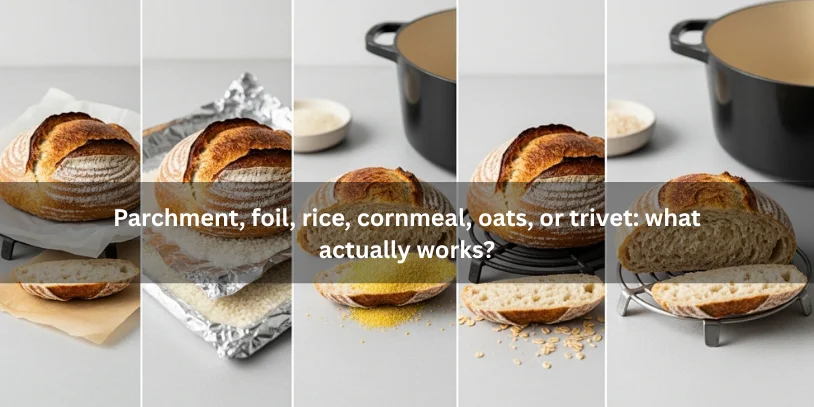
Bakers often experiment with barriers between the loaf and the pot. Some work better than others depending on the setup.
| Option | Best use | Watch out for |
|---|---|---|
| Parchment paper | Easy first fix | Mild effect only in very aggressive ovens |
| Double parchment | Stronger barrier | Can wrinkle or darken |
| Foil disk barrier | Good for intense cast iron heat | Too much can leave the bottom pale |
| Rice | Helpful as a buffer in some Dutch ovens | Can toast or darken |
| Cornmeal | Traditional under-loaf layer | Can burn and taste bitter |
| Rolled oats | Light buffer | Can overtoast |
| Trivet or silicone sling | Reduces direct contact | Must be oven-safe |
If you try one of these, use it to support a smarter oven setup, not as the only fix. If your Dutch oven is blazing hot on a low rack, parchment alone may not be enough.
What not to change yet
This is where many bakers lose time.
Do not immediately blame:
- your starter
- fermentation
- shaping
- scoring
- hydration
Those things affect other results, but a burnt bottom is most often a heat management problem. If the loaf is springing and baking reasonably well overall, focus on the oven, vessel, rack position, and bake profile first.
Is it an oven problem or a recipe problem?
Usually it is an oven or vessel problem.
However, recipe factors can make the issue worse:
- Whole-grain bread often needs a longer bake
- Dense loaves stay in contact with heat longer
- Large boules may need more total time
- Added sweeteners can darken crust faster
Still, the bottom itself usually burns because the base is receiving more heat than it should, not because the dough is wrong.
Electric oven vs gas oven
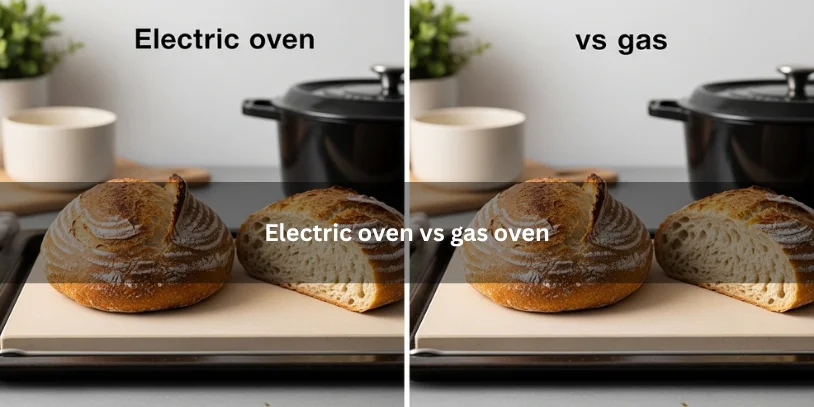
This is a useful distinction that many articles skip.
Electric ovens
Electric ovens often have strong, direct bottom heat and can create more intense scorching under cast iron or steel.
Gas ovens
Gas ovens can also burn the bottom, but some bake with slightly different heat movement. Inconsistent hot spots may be the bigger issue rather than pure bottom intensity.
In both cases, an oven thermometer helps. Many home ovens run hotter or cycle differently than expected.
When to remove the loaf from the Dutch oven
If your loaf has already set its shape and gained oven spring, finishing it outside the Dutch oven can help reduce further bottom scorching.
This is especially useful when:
- the loaf still needs more time for the top and sides
- the bottom is already darkening too quickly
- you are baking a dense loaf that needs a longer finish
You can move the loaf to the oven rack or a cooler tray near the end. Just do it carefully and only once the structure is strong enough.
A simple decision tree for your next bake
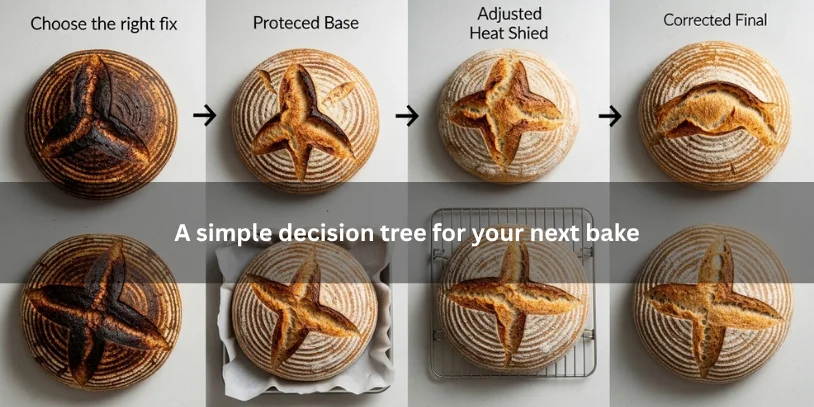
Use this practical framework.
Problem: Burnt bottom only
Do this first:
- move to middle rack
- add a sheet pan below
Problem: Burnt bottom and pale top
Do this first:
- raise the loaf higher
- reduce direct-contact heat
- check oven accuracy with an oven thermometer
Problem: Thick dark bottom but loaf is otherwise fine
Do this first:
- lower temperature slightly
- shorten uncovered bake
- try double parchment or a foil barrier
Problem: Only whole wheat or larger loaves burn
Do this first:
- protect the bottom more aggressively
- consider finishing the loaf outside the pot
- avoid extra-long contact with a superheated base
A realistic baking example
Let’s say you preheat a cast iron Dutch oven for 45 minutes, bake at high heat, and keep the loaf in the pot for the full bake. Your loaf gets good oven spring, but the bottom is nearly black.
The smartest next test is not changing the dough.
It is this:
- same dough
- same shaping
- same bake day
- loaf on middle rack
- empty sheet pan underneath
- slightly lower heat after loading
That tells you fast whether bottom heat was the main issue. In many kitchens, it is.
Tools that help
You do not need to buy much, but a few tools make troubleshooting easier:
- Oven thermometer for checking true temperature
- Parchment paper for easier loading and mild insulation
- Sheet pan as a bottom heat buffer
- Silicone sling or trivet if oven-safe and suited to your vessel
- Lighter-colored pot or pan if your current dark interior runs too hot
There is no strong pricing angle behind this topic, but if you do buy anything, the most practical low-cost improvement is usually an oven thermometer and a simple sheet pan buffer.
The best mindset for solving this
Treat it like a heat-transfer problem, not a mystery.
Start with the easiest fix. Test one change at a time. Keep notes on:
- rack position
- bake temperature
- preheat length
- vessel used
- whether you used parchment, foil, rice, or a trivet
- when the loaf left the pot
That is how you stop wasting flour, time, and otherwise good loaves.
FAQs
Why is the bottom of my sourdough burning in a Dutch oven?
Because the loaf is getting too much direct conductive heat from the hot cast iron base. A long preheat, low rack position, and dark pot interior can make it worse.
Should I lower my sourdough baking temperature?
Yes, sometimes. If the bottom is darkening too fast, lowering the temperature slightly after loading the loaf often helps without ruining oven spring.
Does parchment paper stop bread from burning?
It can help, but it is usually not enough by itself in a very hot Dutch oven or on a baking steel. It works best with a higher rack and a sheet pan underneath.
Is a black Dutch oven worse than a light one?
Often, yes. Dark or black interiors can absorb and radiate more heat, which may lead to faster overbrowning on the bottom.
Why is my sourdough pale on top but burnt on the bottom?
That usually means the loaf is receiving too much bottom heat and not enough balanced heat around the rest of the bread. Raise the rack and buffer the heat below.
Can I put foil in a Dutch oven for sourdough?
Yes, as a temporary barrier under the loaf if used safely and appropriately. But do not overdo it, or the bottom may end up too pale instead.
Should I bake sourdough on a baking steel?
You can, but steel is much more aggressive than a baking stone. If your bottom burns easily, steel may not be the most forgiving choice.
Why does whole wheat sourdough burn faster on the bottom?
Whole-grain bread is often denser and may need a longer bake. That extra time leaves the base exposed to high heat longer.
Should I remove bread from the Dutch oven before it is done?
Sometimes. If the loaf has set well and the bottom is already darkening too quickly, finishing outside the pot can help.
Is this an oven problem or a recipe problem?
Most of the time it is an oven setup or vessel issue, not a dough issue.
Conclusion
If the bottom of your sourdough keeps burning, the problem is usually too much direct bottom heat, not bad dough. Start with the simplest fixes first: move the loaf to the middle rack, place a sheet pan underneath, and lower the baking temperature slightly if needed.
From there, adjust based on your setup. A Dutch oven, baking stone, baking steel, dark interior pot, whole-grain loaf, and long bake time all change how heat moves into the bread. Once you test one variable at a time, the burnt bottom problem becomes much easier to solve, and your sourdough gets more consistent from bake to bake.