
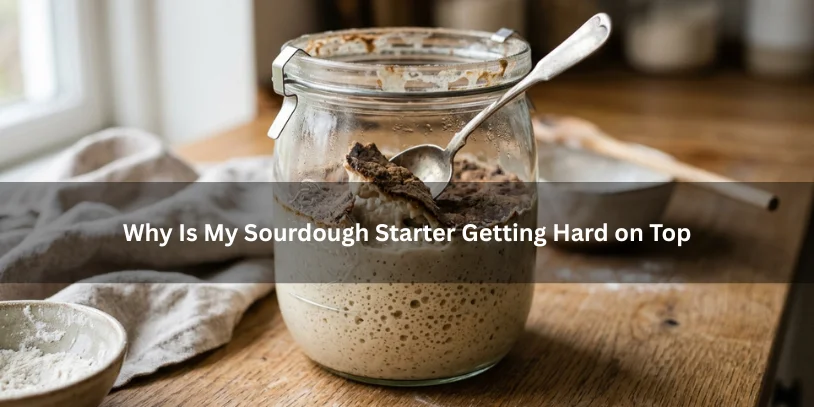
Your sourdough starter is getting hard on top because the exposed surface is drying out. This usually happens when too much air reaches the starter, the mixture is too thick, the room is dry, the starter is underfed, or it is stored uncovered in the fridge.
In most cases, a hard top is not a sign that your starter is dead. It is often just a dry skin or crust sitting over healthy starter underneath.
A sourdough starter is a living mixture of flour, water, wild yeast, and lactic acid bacteria. These microorganisms ferment the flour, produce carbon dioxide, create acidity, and help develop the flavor and rise in sourdough bread. But because the starter contains water, its surface can dry out when exposed to air for too long.
If the top looks beige, tan, grayish, dry, or leathery, you can usually remove that layer and feed the starter. If it looks fuzzy, pink, orange, green, black, or smells rotten, it is safer to discard it and start again.
Is a Hard Top on Sourdough Starter Safe?
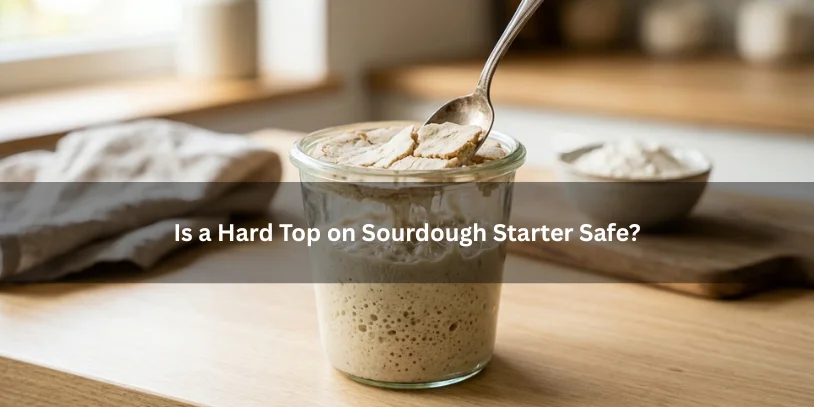
A hard top is usually safe when it is only dry, crusty, or leathery. It often means moisture has evaporated from the surface, especially if the starter was covered with cloth, paper towel, or a loose breathable cover.
The starter underneath may still be perfectly usable if it smells pleasantly sour, yeasty, fruity, or mildly tangy.
Use this quick check:
| What You See | What It Usually Means | What to Do |
|---|---|---|
| Beige dry crust | Surface dried out | Remove crust and feed |
| Leathery skin | Too much airflow | Peel off and use better cover |
| Grayish dry layer | Oxidation or drying | Remove and refresh |
| Dark liquid on top | Hooch from hunger | Stir in or pour off, then feed |
| Fuzzy patches | Mold | Discard starter |
| Pink or orange streaks | Contamination | Discard starter |
| Rotten smell | Spoilage | Discard starter |
A dry crust is different from mold. Mold usually looks fuzzy, raised, colorful, or patchy. A dry starter skin looks flat, tough, cracked, or rubbery.
Main Reasons Your Sourdough Starter Forms a Hard Top
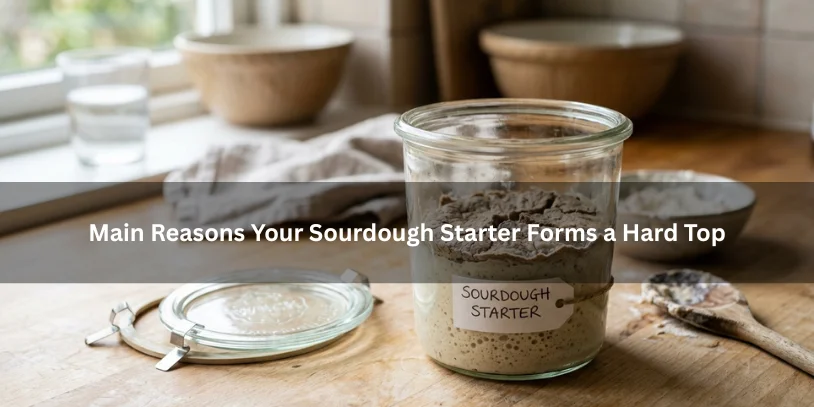
1. Too Much Air Is Reaching the Surface
This is the most common reason. Many beginners cover their starter with a paper towel, cheesecloth, coffee filter, or thin cloth because they think the starter needs to “breathe.”
A starter does produce gas, especially carbon dioxide, but it does not need to be exposed to open air all day. Too much airflow pulls moisture from the surface and creates a dry layer.
A better option is a loose-fitting lid. It protects the starter from drying while still allowing gas to escape.
Good cover options include:
- A jar lid placed loosely on top
- A plastic lid not fully tightened
- A silicone fermentation lid
- A small plate over the jar
- Reusable wrap placed lightly over the opening
Avoid leaving the starter fully uncovered or covered only with cloth for long periods, especially in a dry kitchen.
2. Your Starter Is Too Thick
If your sourdough starter is too thick, it can dry out faster on top. This often happens when you feed by volume instead of weight.
For example, one cup of flour and one cup of water are not equal by weight. Flour is much lighter than water, so feeding by cups can accidentally create a stiff starter.
A common balanced starter is 100% hydration, which means equal weights of flour and water.
Example:
- 50g starter
- 50g water
- 50g flour
This creates a thick, batter-like texture. If your starter looks more like dough, paste, or clay, it may need more water.
3. Your Kitchen Is Dry
Dry air speeds up evaporation. If you live in a dry climate, high-altitude area, or a home with strong heating or air conditioning, your starter may form a skin faster than expected.
This can happen in:
- Winter kitchens
- Air-conditioned rooms
- Homes with fans running
- Hot, dry climates
- High-altitude locations
- Kitchens near open windows
In humid climates, the starter may stay softer on top, but it can ferment faster. In dry climates, the main challenge is usually moisture loss from the surface.
4. The Starter Is Hungry or Underfed
A neglected starter can become dry, acidic, and weak. When wild yeast and lactic acid bacteria consume the available flour, the starter runs out of food. It may collapse, smell sharp, form hooch, or develop a dry top.
Signs your starter needs feeding include:
- Strong alcoholic smell
- Acetone or nail polish remover smell
- Liquid on top
- No recent rise
- Very sour smell
- Thick or separated texture
- Dry crust on the surface
If the starter is hungry but not moldy, it can usually be refreshed with regular feeding.
5. It Is Drying Out in the Refrigerator
A sourdough starter can still dry out in the fridge. Cold temperatures slow fermentation, but refrigerator air is often dry. If the starter is stored with a cloth cover or a loose paper towel, the top can harden.
For fridge storage, use a jar with a proper lid. It does not need to be clamped down aggressively, but it should protect the starter from dry air.
A refrigerated starter is usually fine with less frequent feeding, but it should not be forgotten for months without checking.
6. The Jar Has Too Much Empty Space
If you keep a small amount of starter in a very large jar, there is more air sitting above the surface. More air can mean more drying.
Choose a jar that gives the starter enough room to double or triple, but not so much empty space that the surface dries quickly.
A clear glass jar is ideal because you can see bubbles, rise, collapse, hooch, and texture changes.
How to Fix Sourdough Starter That Is Hard on Top
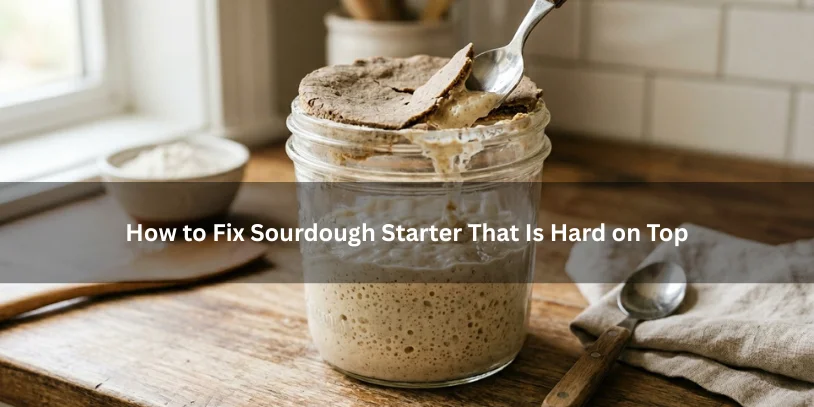
If the top is dry but not moldy, follow these steps.
Step 1: Inspect the Surface
Look closely before stirring.
Check for:
- Fuzzy growth
- Pink, orange, green, or black spots
- Rotten smell
- Slimy texture
- Dry beige or gray crust
If it is fuzzy or oddly colored, discard it. If it is simply dry and crusty, continue.
Step 2: Remove the Hard Layer
Use a clean spoon to lift off the dry top. Do not mix a tough crust back into the starter. It may leave dry bits in your dough later.
If the starter underneath looks creamy, bubbly, beige, and smells sour or yeasty, it is likely usable.
Step 3: Move Healthy Starter to a Clean Jar
Take a small amount from underneath the dry layer and place it into a clean jar.
A simple refreshment ratio:
- 20g starter
- 40g water
- 40g flour
Mix until smooth. This 1:2:2 feeding gives the starter fresh food and helps reduce excess acidity.
Step 4: Cover It Properly
Place a loose lid on the jar. Do not use only a cloth cover if your starter keeps drying out.
At room temperature, avoid sealing a highly active starter completely airtight because gas pressure can build. A loose lid is usually the safest everyday option.
Step 5: Watch for Activity
After feeding, the starter should begin to bubble and rise. Depending on room temperature and starter strength, this may take a few hours or longer.
A healthy starter usually:
- Smells tangy, yeasty, or mildly fruity
- Forms bubbles
- Rises after feeding
- Has a soft, moist surface
- Doubles when strong and mature
If it does not rise after one feeding, repeat the process for a few feeding cycles.
Should You Stir the Hard Top Back In?
It is better not to stir the hard top back into your starter.
A thin, slightly dry skin may dissolve, but a thick crust can create unpleasant dry pieces. It may also make it harder to judge the true texture of the starter.
The better approach is:
- Remove the dry layer.
- Keep the healthy starter underneath.
- Feed with fresh flour and water.
- Use a better cover going forward.
Think of the dry top as a protective but unwanted layer. The good part is usually underneath.
Hard Top vs Mold vs Hooch vs Kahm Yeast
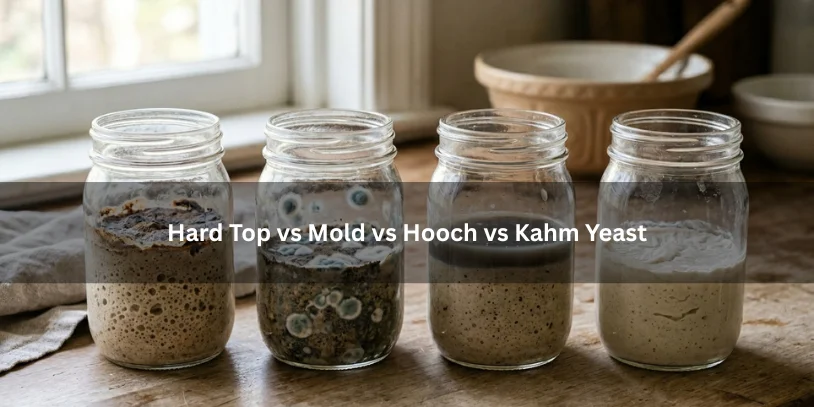
Beginners often confuse these sourdough starter problems because they all appear on the surface.
| Issue | Appearance | Smell | Safe? | Best Action |
|---|---|---|---|---|
| Hard top | Dry, crusty, beige, leathery | Sour or neutral | Usually safe | Remove crust and feed |
| Mold | Fuzzy, colored, patchy | Musty or rotten | Unsafe | Discard starter |
| Hooch | Gray, brown, or black liquid | Alcoholic | Usually recoverable | Feed more often |
| Kahm-like film | Thin, pale film | Odd or yeasty | Use caution | Refresh from clean portion |
| Oxidized top | Gray dry layer | Sharp but not rotten | Often recoverable | Remove and feed |
The most important safety rule is simple: do not try to save a starter with visible mold, pink streaks, orange streaks, or a rotten odor.
Best Cover for Sourdough Starter
The best cover depends on how and where you store your starter.
| Cover Type | Best For | Pros | Cons |
|---|---|---|---|
| Loose jar lid | Daily starter care | Prevents drying, releases gas | Must not be tightened too much |
| Silicone lid | Regular feeding | Easy and reusable | May fit some jars poorly |
| Plastic lid | Fridge storage | Helps prevent drying | Can trap pressure if too tight |
| Cloth cover | Short-term airflow | Simple and cheap | Often causes dry skin |
| Paper towel | Early experiments | Easy to replace | Dries starter quickly |
| Airtight lid | Fridge storage only | Reduces moisture loss | Not ideal for active room-temp starter |
For most home bakers, a loose lid is the easiest and most reliable choice.
How Hydration Affects a Hard Starter Top
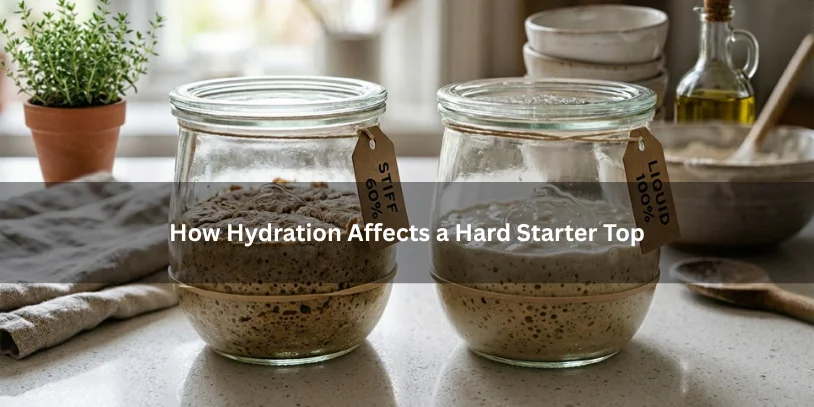
Hydration is one of the biggest reasons starters behave differently.
A liquid starter has more water and is less likely to crust quickly. A stiff starter has less water and may form a dry surface faster, especially in dry air.
| Starter Type | Texture | Dry Top Risk |
|---|---|---|
| High-hydration starter | Loose and pourable | Lower |
| 100% hydration starter | Thick batter | Moderate |
| Stiff starter | Dough-like | Higher |
| Neglected starter | Separated, acidic, dry | High |
If your starter keeps getting hard on top, try feeding with equal weights of flour and water. Use a digital scale instead of cups for better consistency.
Can You Bake With Starter That Had a Hard Top?
Yes, but use the healthy starter underneath, not the dry crust.
Before baking, refresh the starter and wait until it becomes active. It should rise, bubble, and smell pleasantly sour. If it is weak, flat, or overly acidic, give it another feeding before using it in bread dough.
For best results, bake with starter when it is near peak rise. That means it has risen well after feeding and has not fully collapsed yet.
How to Prevent Your Starter from Getting Hard on Top Again
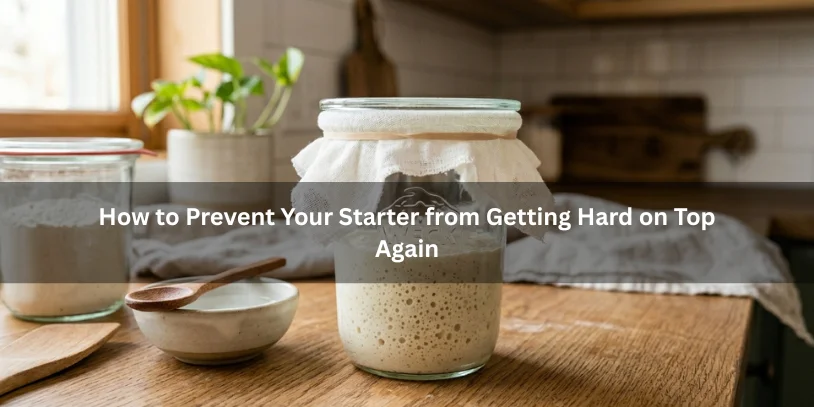
Once you fix the starter, prevention is simple.
Use this checklist:
- Cover with a loose lid instead of cloth
- Feed with equal weights of flour and water
- Keep the jar away from fans, heaters, and direct sun
- Use a jar with reasonable headspace
- Scrape down the sides after feeding
- Feed before the starter becomes overly hungry
- Store fridge starter with a proper lid
- Adjust hydration slightly in dry climates
- Keep the starter at a stable room temperature
If your kitchen is very dry, you can make the starter slightly wetter or use a more protective lid. If your kitchen is hot and humid, you may need to feed more often because fermentation happens faster.
What If the Starter Is Hard All the Way Through?
If the entire starter is hard, not just the surface, it may be severely dried out. This can happen if it was left too long without feeding or stored poorly.
You can try to revive it if there is no mold or bad smell.
Try this:
- Break off a clean piece from the center.
- Add warm water and let it soften for 20–30 minutes.
- Stir until it loosens.
- Add fresh flour.
- Feed again after it shows signs of activity.
If it smells rotten or shows colored mold, throw it away and start fresh.
Common Beginner Mistakes That Cause a Hard Top
Using Cloth for Every Situation
A cloth cover may seem natural, but it often lets in too much air. If your starter forms a skin every day, change the cover first.
Feeding Without Measuring
Too much flour and too little water can create a stiff starter. A digital kitchen scale makes feeding more accurate.
Leaving the Starter Near Heat
Heat speeds fermentation and can dry the surface. Avoid storing the jar near ovens, sunny windows, heaters, or warm appliances.
Forgetting the Starter After It Peaks
Once a starter rises and falls, it becomes hungry. If it sits too long, it may smell alcoholic, form hooch, or dry out on top.
Ignoring Mold Signs
Dry crust can be fixed. Mold should not be ignored. If the starter is fuzzy or has pink, orange, green, or black growth, discard it.
FAQs
1. Why does my sourdough starter form a skin overnight?
Your sourdough starter forms a skin overnight because the surface loses moisture while sitting. This is most common when the jar is covered with cloth, stored in dry air, or mixed too thick.
2. Is a hard top on sourdough starter mold?
Usually, no. A hard top is often dried starter. Mold is usually fuzzy, patchy, raised, and may be green, blue, black, pink, or orange. If you see mold, discard the starter.
3. Should I scrape off the dry layer?
Yes. Scrape off the dry layer and keep the healthy starter underneath if it smells normal and shows no mold. Then feed it with fresh flour and water.
4. Can I stir the crust back into my sourdough starter?
It is not recommended. A hard crust may not dissolve properly and can leave dry pieces in your starter or bread dough. Remove it instead.
5. Why does my sourdough starter get hard in the fridge?
Your starter can get hard in the fridge because refrigerator air is dry. If the container is not covered well, the surface loses moisture and forms a crust.
6. Should sourdough starter be airtight?
At room temperature, a starter should usually be loosely covered, not tightly sealed. It needs to release gas. In the fridge, a fitted lid is usually fine because fermentation slows down.
7. What does bad sourdough starter look like?
Bad sourdough starter may have fuzzy mold, pink or orange streaks, green or black spots, slimy texture, or a rotten smell. These are signs to discard it.
8. Is my sourdough starter dead if it has a crust?
Not always. If only the top is dry and the starter underneath smells sour, yeasty, or tangy, it may still be alive. Remove the crust and feed the healthy portion.
9. How do I stop my starter from drying out?
Use a loose lid, feed with proper hydration, keep it away from drafts, avoid oversized jars, and store fridge starter with a proper cover.
10. Why does my starter smell like alcohol and have a dry top?
An alcoholic or acetone-like smell usually means the starter is hungry. Remove any dry crust, feed it regularly, and consider using a higher feeding ratio like 1:2:2.
Conclusion
A sourdough starter that gets hard on top is usually drying out, not dying. The most common causes are too much airflow, a cloth or paper cover, low hydration, dry room conditions, missed feedings, or poor fridge storage.
If the top is dry, beige, grayish, or leathery, remove it and feed the healthy starter underneath. If you see fuzzy mold, pink or orange streaks, green or black patches, or smell something rotten, discard the starter.
To prevent the problem from coming back, use a loose lid, feed by weight, keep the starter moist but not runny, avoid dry airflow, and store it in a clean jar with the right amount of space. With a few small changes, your starter should stay soft, bubbly, active, and ready for bread.