
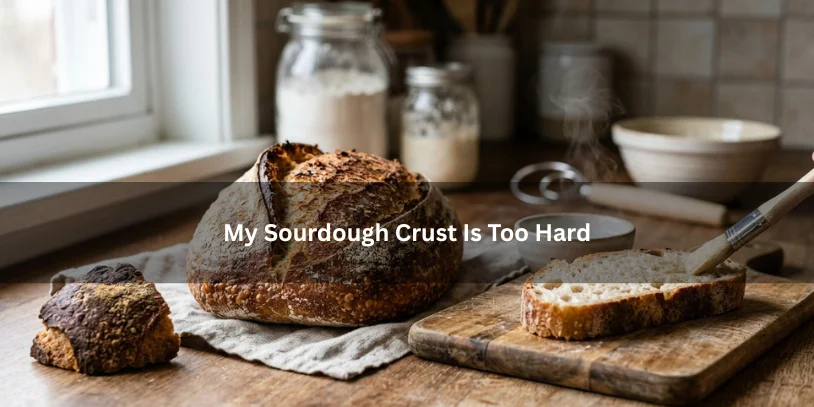
If your sourdough crust is too hard, the outside of the loaf has dried, thickened, or set too aggressively during baking or storage. The most common causes are not enough steam, too much uncovered baking, low dough hydration, excessive bottom heat, overbaking, or poor storage after cooling.
A good sourdough crust should be crisp, flavorful, and slightly chewy. It should not feel like armor. If the crust hurts your mouth, breaks into sharp pieces, or makes the loaf difficult to slice, the bake needs adjustment.
This problem is common with homemade sourdough, especially when using a Dutch oven, baking stone, cast iron pot, or high oven temperature. The loaf may look beautiful on the outside, but the eating experience becomes tough, dry, or unpleasant.
The fix is usually simple: control steam, reduce dry heat, adjust hydration, protect the bottom crust, and store the bread properly.
Quick Answer: Why Is My Sourdough Crust So Hard?
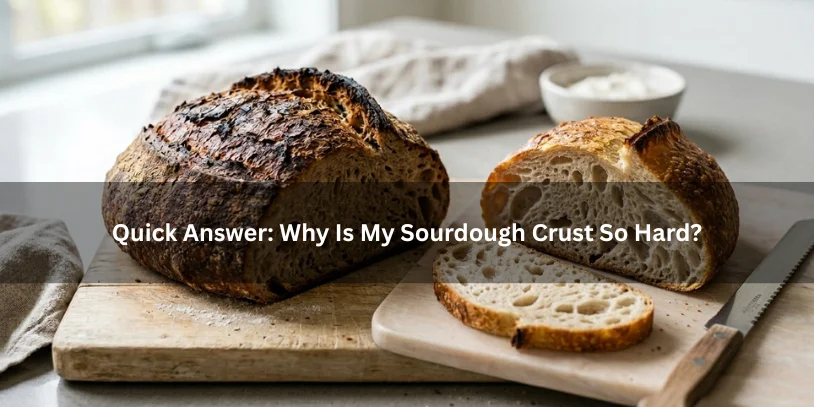
Your sourdough crust is too hard because the surface lost too much moisture. This usually happens from low steam, long uncovered baking, high oven heat, low hydration, excess flour on the dough surface, or leaving the loaf exposed after baking.
The crust forms when heat dries and browns the outside of the dough. During a good bake, steam keeps the dough surface flexible long enough for oven spring. If the crust sets too early, it becomes thick and tough instead of thin and crisp.
Is Sourdough Crust Supposed to Be Hard?
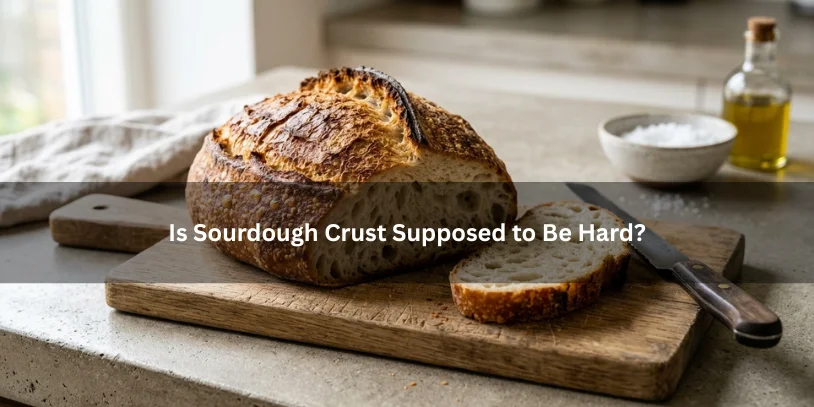
Sourdough crust is supposed to be firm and crisp, but not painfully hard.
There is a difference between a good crispy crust and a problem crust.
| Crust Type | What It Means | Is It Good? |
|---|---|---|
| Crispy crust | Thin, brittle, pleasant crunch | Yes |
| Crunchy crust | Firm but easy to bite | Usually yes |
| Hard crust | Difficult to cut or chew | No |
| Thick crust | Dense outer shell | Usually not ideal |
| Leathery crust | Chewy, rubbery, tough | Not ideal |
| Burnt crust | Bitter, dark, overly dry | No |
A crispy sourdough crust should crackle lightly when cut. A hard sourdough crust fights the knife.
Quick Diagnosis: Match the Symptom to the Cause
| Problem | Likely Cause | Best Fix |
|---|---|---|
| Crust is hard all over | Not enough steam or overbaking | Bake covered longer and reduce uncovered time |
| Bottom crust is too hard | Too much heat from Dutch oven or baking stone | Add a baking sheet underneath |
| Crust is thick and chewy | Long dry bake | Shorten uncovered bake |
| Crust is hard but crumb is soft | Surface dried too fast | Increase steam and lower finish temperature |
| Crust is hard and crumb is dry | Overbaked or low hydration | Increase hydration and reduce bake time |
| Crust gets hard next day | Poor storage | Use airtight storage after cooling |
| Crust is pale but tough | Dry oven, weak steam | Add steam early in baking |
| Crust is burnt and hard | Oven too hot | Lower temperature after oven spring |
This table is the easiest way to troubleshoot your loaf without changing everything at once.
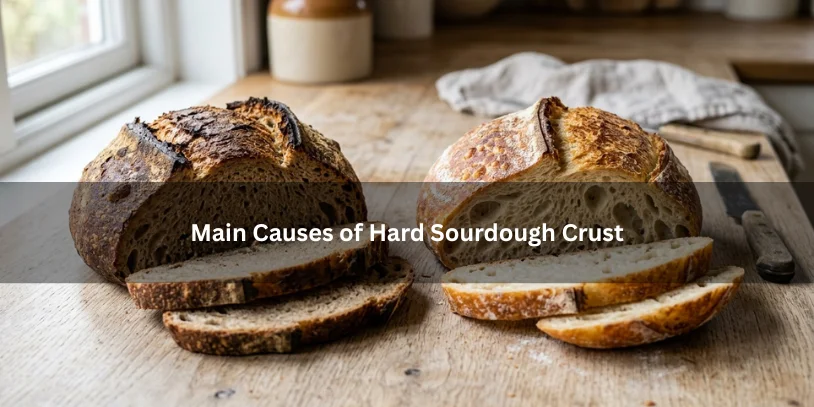
Main Causes of Hard Sourdough Crust
1. Not Enough Steam During Baking
Steam is one of the biggest factors in sourdough crust texture.
At the beginning of baking, sourdough needs a moist environment. Steam keeps the outer dough layer soft and flexible while the loaf expands. This early expansion is called oven spring.
Without enough steam, the surface dries too quickly. Once the crust sets, the loaf cannot expand smoothly. The result is often a hard, thick, dull, or tough crust.
How to fix it
Use one of these steam methods:
- Bake in a Dutch oven
- Use a covered baker or bread cloche
- Cover the loaf with an inverted metal bowl
- Add a tray of hot water to the oven
- Mist the dough lightly before covering
- Bake on a stone with steam below
For most home bakers, a Dutch oven is the easiest option because it traps the dough’s own moisture.
2. Baking Uncovered for Too Long
Most sourdough recipes use two baking stages:
- Covered baking for steam and oven spring
- Uncovered baking for browning and crust development
If the uncovered stage is too long, the crust keeps drying. This can turn a crisp crust into a thick, hard shell.
This is especially common when people remove the Dutch oven lid too early and continue baking at high heat.
Better baking schedule
Try this softer-crust baking method:
| Stage | Temperature | Time |
|---|---|---|
| Covered bake | 450°F / 232°C | 25–30 minutes |
| Uncovered bake | 400–425°F / 204–218°C | 10–18 minutes |
| Cooling | Room temperature | 2–3 hours |
If your crust is always too hard, extend the covered stage and shorten the uncovered stage.
3. Oven Temperature Is Too High
A hot oven helps sourdough rise, but too much heat for too long can make the crust hard.
Many recipes start around 450°F to 500°F. That high heat can work well, but if your oven runs hot or your Dutch oven holds too much heat, the crust may overdevelop.
Cast iron is excellent for oven spring, but it also stores intense heat. That heat can make the bottom crust especially hard.
How to fix it
Use high heat at the beginning, then lower it.
Example:
- Preheat Dutch oven at 450°F / 232°C.
- Bake covered for 25 minutes.
- Remove the lid.
- Reduce oven to 400–425°F / 204–218°C.
- Bake until the crust is golden brown, not overly dark.
An oven thermometer is useful because many home ovens run hotter or cooler than the dial says.
4. Dough Hydration Is Too Low
Hydration means the amount of water compared to flour in your dough.
Low hydration dough is easier to shape, but it can produce a firmer crumb and tougher crust. Higher hydration dough contains more water, which creates more steam inside the loaf during baking.
This does not mean every loaf needs to be extremely wet. But if your sourdough crust is always thick and hard, your dough may need a little more water.
Simple hydration example
If your recipe uses:
- 500g flour
- 325g water
That is 65% hydration.
To make it 70% hydration:
- 500g flour
- 350g water
That small increase can help create a softer crumb and thinner crust.
Best approach
Increase hydration slowly.
Do not jump from 65% to 80% in one bake. Try adding 10–25g more water per 500g flour and see how your dough behaves.
5. The Loaf Is Overbaked
Overbaking removes too much moisture from the bread. This can make both the crust and crumb dry.
A dark crust is not always bad. Many artisan sourdough loaves have a deep brown crust with rich flavor. But if the crust is bitter, extremely hard, or nearly black, the loaf is probably baked too long or too hot.
Signs of overbaked sourdough
- Very dark crust
- Dry crumb
- Hard bottom
- Bitter flavor
- Crust flakes aggressively
- Loaf feels unusually light and dry
How to fix it
Reduce the uncovered bake by 5–10 minutes.
You can also check doneness with an instant-read thermometer. Many lean sourdough loaves are fully baked around 200–210°F / 93–99°C internally, depending on loaf size and formula.
6. Too Much Bottom Heat
If only the bottom crust is too hard, the issue is probably heat transfer.
A Dutch oven, baking stone, or baking steel can push intense heat into the base of the loaf. This is useful for oven spring, but too much bottom heat creates a thick, tough, or burnt base.
How to fix hard bottom crust
Try these adjustments:
- Put a baking sheet on the rack below the Dutch oven
- Move the Dutch oven one rack higher
- Use parchment paper under the dough
- Lower the oven temperature after loading
- Reduce Dutch oven preheat time slightly
- Add a thin layer of semolina or cornmeal
The easiest fix is placing an empty baking sheet under the Dutch oven. It acts as a heat shield
7. Too Much Flour on the Dough Surface
Extra flour can make shaping easier, but too much flour on the outside of the dough can dry into a thick crust.
Rice flour is often used for dusting bannetons because it prevents sticking. But if there is a heavy layer on the loaf, it can contribute to a dry, tough surface.
How to fix it
Use less dusting flour.
Before baking, gently brush off excess flour from the dough surface. You only need enough to prevent sticking, not a visible coating.
8. Cooling and Storage Problems
A loaf keeps changing after it comes out of the oven.
If you leave sourdough uncovered for too long, the crust can become harder as moisture escapes. If you seal it too soon while hot, trapped condensation can make the crust leathery.
Correct cooling method
- Remove bread from the oven.
- Place it on a wire cooling rack.
- Let it cool completely before slicing.
- Store it based on how soon you will eat it.
For a boule or large loaf, cooling can take 2–3 hours.
Best storage for softer crust
If you want the crust to stay softer:
- Store in a plastic bag after cooling
- Use an airtight container
- Wrap in foil
- Freeze sliced bread for longer storage
If you want the crust crisp for the first day, leave it cut-side down on a board or loosely covered. But after that, exposed bread will dry out.
How to Fix Hard Sourdough Crust After Baking
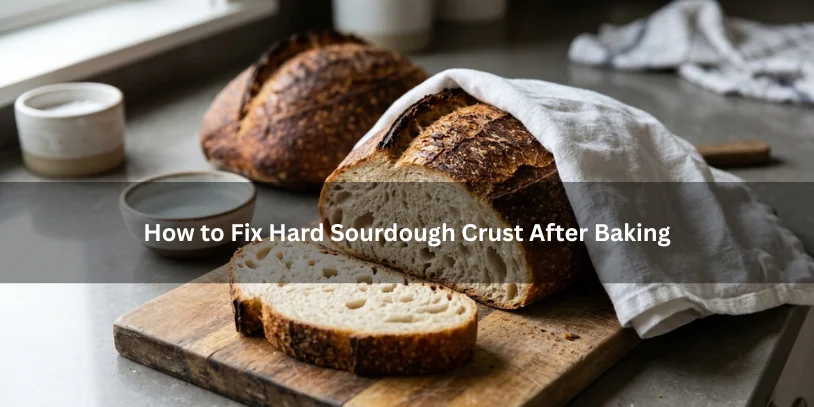
If the bread is already baked, you cannot fully reverse the crust, but you can soften it.
Method 1: Light Water Refresh
This works well for a loaf that became hard after cooling or storage.
- Lightly mist the crust with water.
- Place the loaf in a 350°F / 177°C oven.
- Warm for 10–15 minutes.
- Let it rest briefly before slicing.
Do not soak the loaf. A light mist is enough.
Method 2: Towel Softening
If the bread is still slightly warm:
- Wrap it in a clean kitchen towel.
- Let it sit for 20–30 minutes.
- Move it to proper storage once fully cool.
This traps a little moisture and softens the outer crust.
Method 3: Slice and Toast
If the crust is too hard to enjoy fresh, slice the loaf and use it for:
- Toast
- Soup dipping
- Croutons
- Bruschetta
- Grilled sandwiches
- Breadcrumbs
A hard-crust loaf is not wasted. It may simply need a different use.
How to Make Sourdough Crust Softer Next Time
Use More Steam
Bake covered longer or improve steam in the oven. Steam delays crust formation and helps prevent a thick shell.
Reduce Uncovered Baking Time
If your recipe says 25 minutes uncovered, try 15 minutes instead. Watch the crust color, not only the clock.
Lower the Finishing Temperature
After removing the lid, reduce the oven from 450°F to 400–425°F. This allows browning without excessive drying.
Increase Hydration Slightly
Add a little more water to the dough. Start with a small increase so the dough remains manageable.
Add Fat for a Softer Loaf
If you prefer a sandwich-style sourdough, add a little fat.
Good options include:
- Olive oil
- Butter
- Milk
- Yogurt
- Egg
- Honey
This changes the bread style. A lean artisan loaf has a crisper crust, while enriched dough gives a softer crust.
Brush the Crust After Baking
For a softer finish, brush the hot crust with:
- Melted butter
- Olive oil
- Milk
- Water
Butter gives the softest crust. Water gives a lighter softening effect.
Dutch Oven vs Open Bake for Crust Control
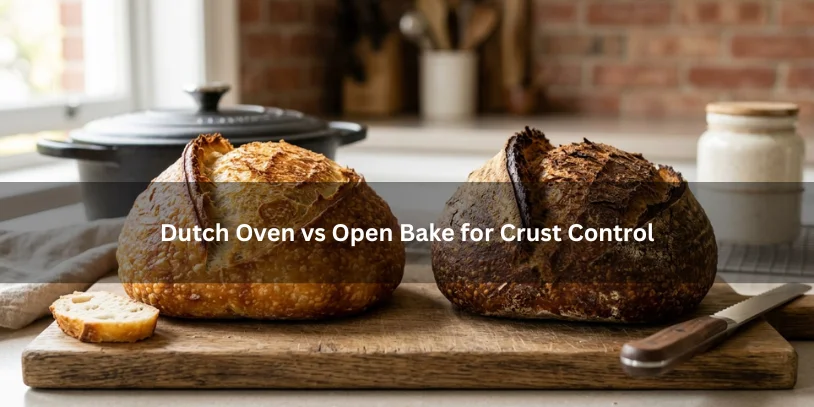
| Method | Pros | Cons |
|---|---|---|
| Dutch oven | Traps steam, improves oven spring, easier for beginners | Can make bottom crust too hard |
| Baking stone with steam | Good for multiple loaves, strong crust | Harder to control steam |
| Covered baker | Excellent steam control | Requires special equipment |
| Open tray bake | Simple setup | Crust may set too early |
| Metal bowl cover | Budget-friendly steam method | Can be awkward to handle |
If your sourdough crust is too hard in a Dutch oven, the Dutch oven is not necessarily the problem. The issue is usually timing, temperature, or bottom heat.
Climate and Kitchen Conditions Matter
Sourdough crust behaves differently depending on your environment.
Dry Climates
In dry climates, bread loses moisture quickly after baking. The crust may become hard within hours.
Helpful fixes:
- Bake covered longer
- Store sooner after cooling
- Use airtight storage after the first day
- Increase hydration slightly
Humid Climates
In humid climates, crust may soften instead of harden. The loaf can lose crispness quickly.
Helpful fixes:
- Cool fully on a rack
- Avoid sealing too soon
- Toast slices before serving
- Use a bread box for short-term storage
High-Altitude Areas
At higher altitudes, moisture loss can happen faster and dough may behave differently.
Helpful fixes:
- Watch the dough, not just the recipe timing
- Increase water slightly
- Use an oven thermometer
- Reduce excessive uncovered baking
Gas Ovens
Gas ovens may vent moisture more quickly than electric ovens. If your crust is always hard, a covered baking method can help keep steam around the loaf.
Tools That Help Prevent Hard Crust
You do not need every baking tool, but a few can make crust control easier.
| Tool | Why It Helps |
|---|---|
| Dutch oven | Traps steam during early bake |
| Oven thermometer | Shows actual oven temperature |
| Instant-read thermometer | Prevents overbaking |
| Baking sheet | Shields bottom crust from harsh heat |
| Parchment paper | Reduces direct contact with hot cast iron |
| Cooling rack | Prevents uneven cooling |
| Bread box | Helps short-term storage |
| Airtight bag | Keeps crust softer after cooling |
| Water mister | Adds surface moisture before baking |
If you buy only one tool, choose based on your problem. For hard crust all over, use a Dutch oven or covered baker. For hard bottom crust, use a baking sheet as a heat shield. For repeated overbaking, use a thermometer.
Common Mistakes That Make Sourdough Crust Hard
Removing the Lid Too Early
The loaf needs steam early in baking. Removing the lid too soon can set the crust before the bread fully expands.
Baking Until Very Dark Every Time
A bold bake can taste great, but too much browning can become bitter and hard.
Using Too Little Water
Low hydration dough can create a dense loaf with a tough crust.
Leaving the Bread Out Overnight
Open air dries the crust and crumb. This is especially noticeable in dry kitchens.
Slicing Too Soon
Cutting hot bread releases steam from the crumb. This can affect texture and make the loaf dry faster.
Sealing Hot Bread
Do not place hot bread directly into a plastic bag. Trapped steam can make the crust rubbery or leathery.
Changing Too Many Things at Once
If you change hydration, temperature, bake time, flour, and proofing all at once, you will not know what fixed the problem. Change one or two things per bake.
Best Fix by Problem Type
| Your Problem | Best First Change |
|---|---|
| Hard crust all over | Bake covered longer |
| Thick crust | Reduce uncovered bake |
| Hard bottom crust | Add baking sheet under Dutch oven |
| Crust hard next day | Store in airtight bag after cooling |
| Crust hard but inside soft | Improve steam |
| Crust hard and inside dry | Reduce bake time |
| Crust pale but tough | Add steam and improve oven spring |
| Crust leathery | Cool fully before storing |
This approach keeps troubleshooting simple.
FAQs
Why is my sourdough crust so hard?
Your sourdough crust is hard because the surface dried too much during baking or storage. The most common causes are not enough steam, overbaking, high oven heat, low hydration, long uncovered baking, or leaving the loaf exposed after cooling.
Is sourdough crust supposed to be hard?
Sourdough crust should be crisp and firm, but not painfully hard. A good crust should be easy to bite and slice. If it feels like a thick shell, the loaf likely needs more steam, less dry baking, or better storage.
How do I make my sourdough crust softer?
Bake the loaf covered longer, reduce uncovered bake time, lower the oven temperature after removing the lid, increase hydration slightly, and store the cooled loaf in an airtight bag if you prefer a softer crust.
Why is the bottom of my sourdough so hard?
The bottom crust gets too hard when it receives too much direct heat from a Dutch oven, baking stone, or baking steel. Place a baking sheet on the rack below, use parchment, or move the loaf higher in the oven.
Does steam make sourdough crust softer?
Steam helps keep the dough surface flexible during early baking. It delays crust setting, supports oven spring, and can prevent the crust from becoming too thick or hard.
Can I soften sourdough crust after baking?
Yes. Lightly mist the loaf with water and warm it in a 350°F / 177°C oven for 10–15 minutes. You can also wrap a slightly warm loaf in a clean towel for 20–30 minutes.
Does low hydration cause hard sourdough crust?
Low hydration can contribute to a tougher crust because the dough contains less water. Increasing hydration gradually can help create more internal steam, a softer crumb, and a thinner crust.
Why does my sourdough crust get hard the next day?
Sourdough crust gets hard the next day because moisture continues to leave the bread. Open air, cloth bags, and dry kitchens can make this worse. Store fully cooled bread in an airtight bag if you want a softer crust.
Should I store sourdough in plastic or paper?
Use plastic or airtight storage if you want a softer crust. Use paper or a cloth bag only for short-term storage if you want to preserve crispness. For longer storage, freeze sliced sourdough.
Should I bake sourdough covered longer?
Yes, if your crust is too hard or thick. Baking covered longer keeps steam around the loaf and delays crust formation. Try 25–30 minutes covered, then finish uncovered at a lower temperature.
Conclusion
A hard sourdough crust usually means the loaf lost too much moisture at the surface. The biggest causes are low steam, long uncovered baking, high oven heat, low hydration, too much bottom heat, and poor storage.
For your next bake, start with the easiest fixes: bake covered longer, reduce uncovered time, lower the finishing temperature, and protect the bottom of the loaf with a baking sheet. If the crust is still too hard, increase hydration slightly and use better storage after cooling.