

Sourdough bread is often a little chewy by nature, but there is a big difference between a pleasant artisan chew and a loaf that feels dense, rubbery, gummy, or just plain hard work to eat.
If your bread feels like a jaw workout, the reason is usually one of a few things: underproofing, underbaking, high hydration, strong gluten development, high-protein flour, or a thick crust caused by steam and baking style. Sometimes it is not one issue at all, but a mix of two or three.
The good news is that chewy sourdough is one of the easiest texture problems to troubleshoot once you know where the chewiness is coming from.
First: Is Sourdough Supposed to Be Chewy?

Yes, a little.
A well-made sourdough loaf often has more chew than soft sandwich bread made with commercial yeast. That is normal. Natural fermentation, gluten development, crust formation, and the structure of an artisan loaf all push sourdough toward a slightly firmer bite.
But there is a line.
A good sourdough crumb should feel:
- moist but not wet
- elastic but not rubbery
- tender enough to bite through comfortably
- structured without being dense
If your loaf is chewy in an unpleasant way, you are likely dealing with a process issue rather than normal artisan texture.
The Fast Answer: Why Your Sourdough Is Chewy
Your sourdough bread is usually chewy because of one or more of these factors:
- underproofing
- underbaking
- high hydration dough
- too much gluten development
- bread flour or high-protein flour
- a thick crust from steam or a long covered bake
- slicing before the loaf fully cools
The next step is figuring out whether the chewiness is mainly in the crumb, the crust, or both.
Chewy Crumb vs Chewy Crust

This is the easiest way to narrow down the cause.
If the crumb is chewy
Look first at:
- underproofing
- underbaking
- high hydration
- strong flour
- tight gluten structure
If the crust is chewy
Look first at:
- too much steam
- too long in a Dutch oven with the lid on
- a long overall bake
- how the bread cooled and was stored
If both are chewy
The issue is usually a combination of:
- dough strength
- fermentation timing
- moisture retention
- bake setup
Quick Diagnosis Table

| Symptom | Most Likely Cause | What It Means | Best Fix |
|---|---|---|---|
| Chewy crumb with tight texture | Underproofing | Dough stayed too tight | Extend bulk fermentation or final proof |
| Chewy and gummy center | Underbaking | Crumb did not fully set | Bake longer and cool fully |
| Chewy but very moist crumb | High hydration | Too much retained moisture | Lower hydration slightly or bake longer |
| Tough crust, decent crumb | Too much steam or long covered bake | Crust thickened too much | Shorten covered bake and vent sooner |
| Elastic, springy chew | Strong gluten or high-protein flour | Dough structure is too strong | Reduce handling or blend flour |
| Chewy and dense loaf | Weak fermentation | Not enough gas and expansion | Improve starter strength and proofing |
The Most Common Causes of Chewy Sourdough
1. Underproofing
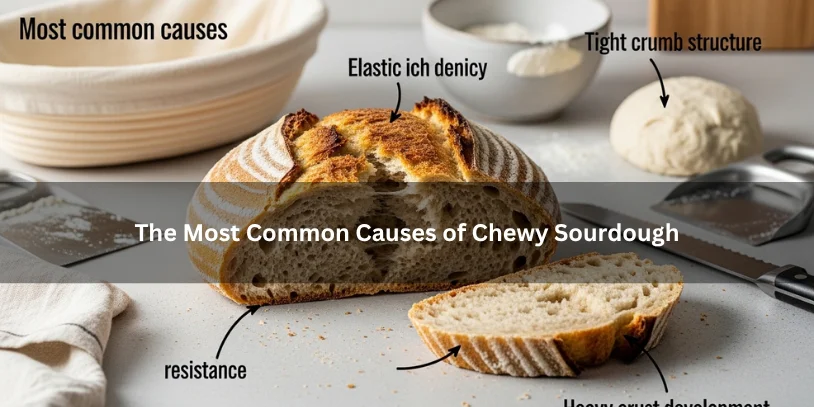
Underproofed sourdough is one of the biggest reasons a loaf turns out chewy and dense.
When bulk fermentation or final proof is too short, the dough has not relaxed enough and has not built enough gas. The result is a tighter crumb, stronger resistance, and a loaf that can feel heavy or rubbery instead of airy.
Signs of underproofed sourdough
- dense crumb
- tight or uneven holes
- strong oven spring with tearing
- chewy middle
- thick, slightly moist texture near the base
This is where a lot of home bakers get tripped up. An underproofed loaf can still have some larger holes and look promising at first glance. Open crumb does not always mean the loaf was properly fermented.
How to fix it
- extend bulk fermentation
- watch dough volume, softness, and airiness instead of only watching the clock
- make sure your sourdough starter is active and strong
- allow more final proof time if the dough still feels tight after shaping
2. Underbaking
Sometimes the loaf is not actually too chewy from fermentation. It is simply not baked through.
If the crumb does not fully set, the inside stays wet, gummy, or tacky. That texture often gets described as chewy, but it is really an incomplete bake problem.
Signs of underbaked sourdough
- wet or shiny crumb
- gummy center
- blade or knife comes away sticky
- center compresses too easily
- crust may brown before the interior fully finishes
How to fix it
- bake longer after removing the lid
- let the crust develop a deeper color
- use an internal temperature check if needed
- cool the bread completely before slicing
Cooling matters more than most people think. A loaf continues to set after it comes out of the oven. Slice too early, and you can mistake trapped steam and unset crumb for a formula issue.
3. High Hydration Dough
High hydration dough can produce a beautiful open crumb, but it can also leave the loaf more elastic and moist. If fermentation or baking is even slightly off, that extra moisture turns into a chewy crumb.
This is especially common when bakers push hydration before they have fully dialed in fermentation, shaping, and bake time.
Signs high hydration is contributing
- moist but not dry-set crumb
- very open but slightly rubbery interior
- chewy bite even when flavor is good
- difficult handling during shaping
How to fix it
- lower hydration slightly on the next bake
- make sure fermentation is complete
- bake long enough to fully set the crumb
- match water level to your flour and skill level
More hydration is not always better. If your loaf is repeatedly too chewy or gummy, lower hydration may actually improve both crumb structure and eating quality.
4. High-Protein Flour or Bread Flour
Bread flour gives strength. Strength often means chew.
That is not bad by itself. In fact, bagels rely on strong flour for their signature bite. But if you want a more tender sourdough loaf, high-protein flour can work against you, especially when paired with strong gluten development and a long bake.
Flour effects on texture
| Flour Type | Texture Result |
|---|---|
| Bread flour | More chew, stronger structure |
| All-purpose flour | Softer, slightly less elastic crumb |
| Whole wheat flour | Heavier feel, can be denser without proper hydration |
| Rye flour | Lower gluten strength but a different kind of moist texture |
| Flour blends | More balanced crumb and chew |
How to fix it
- blend bread flour with all-purpose flour
- avoid choosing the strongest flour just because it sounds more professional
- match flour strength to your texture goal
If you want rustic artisan sourdough, bread flour works great. If you want softer everyday bread, a blend often performs better.
5. Too Much Gluten Development
Gluten development is essential, but too much dough strength can make sourdough feel overly springy and chewy.
This often happens when bakers:
- mix aggressively
- do too many stretch and fold sessions
- use high-protein flour
- combine strong flour with long fermentation and high hydration
Sourdough already develops plenty of structure through time and fermentation. You do not always need to push it harder.
How to fix it
- reduce excessive folds
- stop chasing maximum tension in every step
- handle the dough more gently
- avoid overmixing in the beginning
6. Thick Crust from Steam or Dutch Oven Baking
If your crust is what feels chewy, not the interior, this is the most likely reason.
Steam helps oven spring and crust development. A Dutch oven traps steam very effectively. But too much steam or too long with the lid on can create a thick, leathery crust.
Signs the crust is the main issue
- crumb is acceptable but the outside is tough
- ears and edges are thick
- bread gets even harder to chew after cooling
- crust feels more leathery than crisp
How to fix it
- reduce covered bake time
- uncover the loaf a bit earlier
- avoid overbaking after the lid comes off
- cool on a wire rack so the crust dries evenly
If your goal is a thinner crust, you can also experiment with baking in a loaf tin or Pullman pan instead of always using a Dutch oven.
7. Slicing Too Soon
This one gets overlooked constantly.
Fresh bread smells amazing, so people cut into it while it is still hot. But hot sourdough is still setting internally. Steam is still moving through the crumb. Cut too early, and the texture can turn sticky, wet, or weirdly chewy.
The fix
Wait until the loaf is fully cool before slicing. That alone can make the difference between a gummy chew and a clean, balanced crumb.
Chewy vs Gummy vs Dense: What’s the Difference?

A lot of bakers use these words interchangeably, but they are not the same thing.
| Texture | What It Usually Feels Like | Common Cause |
|---|---|---|
| Chewy | Elastic, resistant bite | Strong gluten, bread flour, mild underproofing |
| Gummy | Wet, sticky, tacky | Underbaking, slicing too early, too much moisture |
| Dense | Heavy, compact, tight | Underproofing, weak fermentation |
| Tough crust | Hard, leathery exterior | Too much steam, long bake, thick crust formation |
Knowing which one you actually have makes troubleshooting much easier.
Why Sourdough Feels Different from Regular Yeast Bread
Sourdough does not behave exactly like bread made with instant yeast or active dry yeast.
That is because sourdough starter contains wild yeast and lactic acid bacteria. During fermentation, acids such as lactic acid and acetic acid influence dough strength, flavor, and texture. Those acids can strengthen gluten and contribute to a more structured, chewy result than a soft commercial sandwich loaf.
That is why many bakers who switch to sourdough for the first time think something went wrong, when really they are just noticing the normal difference between rustic sourdough bread and softer yeast-raised bread.
How to Make Sourdough Less Chewy
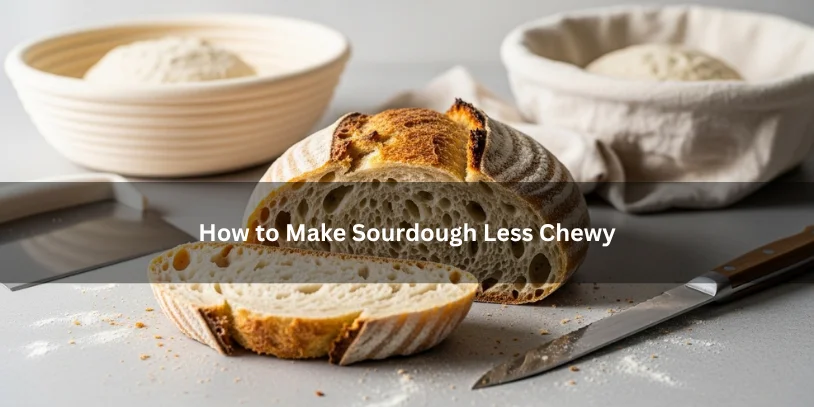
If you want softer sourdough on purpose, do not just guess. Change the variables that actually affect texture.
Best ways to reduce chewiness
- proof fully
- bake thoroughly
- cool completely before slicing
- reduce hydration slightly
- use less bread flour or blend with all-purpose flour
- avoid overdeveloping gluten
- shorten covered bake time if the crust is tough
- use a loaf pan for a softer crust
- add a little fat if making soft sourdough sandwich bread
If you want softer sourdough bread
A rustic boule and a soft sandwich loaf are not the same thing. If your real goal is a tender sandwich-style crumb, use a formula designed for that result instead of trying to force an artisan loaf to behave like enriched bread.
A Simple 5-Step Troubleshooting Process

If your sourdough is too chewy, use this process on your next bake.
Step 1: Identify where the chewiness is
Is it the crumb, the crust, or both?
Step 2: Review fermentation
Was the dough airy enough at the end of bulk fermentation? Did it get enough final proof time?
Step 3: Review flour and hydration
Did you use strong bread flour only? Was hydration too high for your process?
Step 4: Review bake and cooling
Was the loaf fully baked? Did you let it cool before slicing?
Step 5: Change only one or two variables
Do not change everything at once. Otherwise, you will not know what fixed the problem.
Common Mistakes That Make Sourdough Too Chewy
- assuming all chewiness is bad
- confusing gummy with chewy
- blaming hydration alone
- using very strong flour for every loaf
- pushing too much dough strength through endless folds
- underestimating bulk fermentation
- cutting into the loaf too early
- chasing open crumb while ignoring eating quality
The best sourdough is not just photogenic. It should also eat well.
FAQs
Is sourdough supposed to be chewy?
Yes, a little. Mild chew is normal in artisan sourdough, but excessive chewiness usually points to underproofing, underbaking, or too much dough strength.
Why is my sourdough chewy and dense?
That usually means underproofing. The dough did not ferment long enough, so the crumb stayed tight and heavy.
Why is my sourdough chewy but not gummy?
That often points to strong gluten development, high-protein flour, or mild underproofing rather than underbaking.
Why is my sourdough crust chewy?
A chewy crust is commonly caused by too much steam, too long in a Dutch oven with the lid on, or a thick crust from a long bake.
Does bread flour make sourdough more chewy?
Yes. Bread flour usually creates more structure and chew because of its higher protein content.
Does high hydration make sourdough chewy?
It can. High hydration often creates a more elastic crumb, and if baking or fermentation is not fully dialed in, that can feel overly chewy.
Why is my sourdough chewy the next day?
The crust may have thickened during cooling or storage, or the loaf may have retained excess moisture in the crumb.
How do I make sourdough softer?
Use a flour blend with some all-purpose flour, proof fully, bake completely, cool before slicing, and consider a sandwich-style formula if softness is the goal.
Can sourdough have open crumb and still be underproofed?
Yes. Large holes alone do not prove perfect fermentation. A loaf can look open in places and still be texturally underproofed overall.
Conclusion
If your sourdough bread is chewy, the cause is usually not mysterious. It is most often tied to proofing, baking, hydration, flour strength, or crust development.
A little chew is part of what makes sourdough sourdough. But if the loaf feels dense, gummy, rubbery, or tough, start by asking one simple question: is the chewiness in the crumb, the crust, or both?
From there, the fix gets much easier.
For your next loaf, focus on full fermentation, a complete bake, proper cooling, and a flour and hydration level that match the texture you actually want. That is how you move from “why is my sourdough bread chewy?” to a loaf that looks good, tastes great, and eats exactly the way it should.