
If your sourdough looks promising in the banneton but turns flat, spreads wide, or deflates when scored after an overnight cold proof, the problem is usually one of three things: the dough overfermented, underfermented, or never developed enough strength to hold its shape.
Cold proofing, also called a cold retard or cold ferment, slows fermentation, but it does not completely stop it. That is why a flat loaf after fridge proofing is rarely just a “fridge issue.” Most of the time, the real cause starts earlier with bulk fermentation, dough temperature, starter strength, shaping tension, hydration, or oven setup.
What cold proofing does to sourdough
Cold proofing is the final proof done in the refrigerator after shaping. Bakers use it to improve flavor, make scoring easier, and fit bread into a practical schedule.
A cold proof helps in several ways:
- slows fermentation
- develops deeper sourdough flavor
- firms the dough for cleaner scoring
- gives more flexibility on bake timing
But it also comes with a tradeoff. If the dough goes into the fridge too far along, it can still overproof. If it goes in too early, especially in a very cold refrigerator, it may not proof enough at all.
That is why the right question is not only, “Was my cold proof too long?” The better question is, “What was the condition of the dough before it went cold, and what happened during the cold proof?”
The 5 most common reasons sourdough goes flat after cold proofing
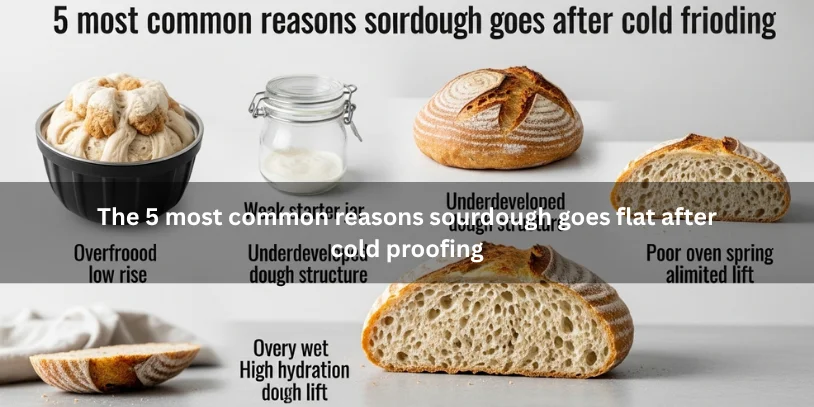
1. The dough overproofed
This is the most common reason.
When sourdough overproofs, the gluten network weakens relative to the amount of gas inside the dough. The loaf may look puffy and airy in the banneton, but once you turn it out, it spreads. When scored, it can deflate instead of opening with strength. In the oven, it may show little oven spring.
Common signs of an overproofed loaf:
- very puffy but fragile dough
- sticky or slack surface
- dough spreads quickly after turning out
- score does not bloom well
- baked loaf is flat with a more even, less springy crumb
Overproofing often starts before the cold proof. If your bulk fermentation already ran long, the refrigerator may only slow a problem that was already happening.
2. The dough was underproofed before the fridge
Flat sourdough is not always overproofed.
Sometimes the dough went into the fridge too early. If bulk fermentation did not go far enough, or the dough lacked enough gas and maturity before shaping, a cold refrigerator can slow fermentation so much that the loaf never catches up. The result can be a loaf that looks dense, tight, and low rather than tall and springy.
Common signs of underproofed dough after cold proof:
- dough feels tight and dense, not airy
- the loaf does not expand much in the oven
- the crumb turns out dense or gummy
- the score may burst unevenly rather than open cleanly
- the loaf feels heavy for its size
This is where many bakers get confused. A low loaf can come from overproofing or underproofing. The difference is in how the dough feels and behaves.
3. The starter or levain was too weak
A weak sourdough starter can make the whole process misleading.
If your starter was underfed, sluggish, or past peak when you mixed the dough, fermentation becomes harder to read. The dough may rise slowly, lack strength, and fail to build enough gas retention for a tall loaf. Some bakers blame the cold proof when the real issue began with poor starter activity.
Signs the starter may be part of the problem:
- dough ferments inconsistently from bake to bake
- bulk takes far longer than expected
- dough lacks energy and lift
- final loaf has weak oven spring even when shaping looks decent
A strong starter should be active, airy, and predictable. If that foundation is weak, the rest of the method becomes harder to control.
4. The dough never built enough strength
Gas alone does not make a loaf rise upward. The dough also needs structure.
If the gluten network is underdeveloped, the dough may ferment but still spread sideways instead of lifting. This is common with high hydration doughs, low-protein flour, too little mixing, or not enough stretch and folds or coil folds during bulk fermentation.
Weak dough strength often shows up as:
- slack dough that will not hold shape
- poor surface tension during shaping
- dough sticking too much during handling
- loaf widening instead of rising
- soft structure with little resistance
This is especially common when bakers jump to very wet dough before mastering fermentation and shaping.
5. The baking setup limited oven spring
Sometimes the dough is close to correct, but the bake works against it.
If your oven is not hot enough, your Dutch oven is not fully preheated, your steam is weak, or your scoring is too shallow or timid, the loaf may not expand properly. That can make a decent loaf look like a fermentation failure.
Bake-related reasons for a flat loaf:
- insufficient preheat
- weak steam
- poor scoring angle or depth
- dough skin dried out in the fridge
- not enough support from the baking vessel
Do not assume every flat loaf is a proofing problem. Sometimes the dough is good, but the oven spring is weak.
How to tell what actually went wrong
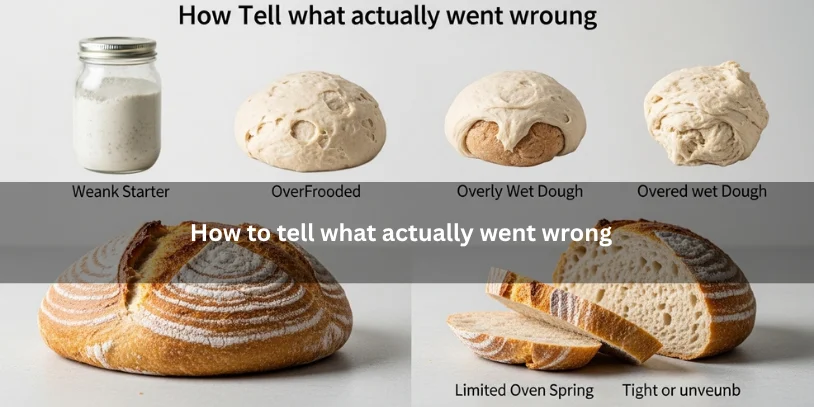
Use this quick symptom table to diagnose the most likely cause.
| What you see | Most likely cause | What to change next |
|---|---|---|
| Dough spreads a lot after turning out | Overproofed or weak structure | Shorten total fermentation or strengthen dough |
| Dough feels tight and dense | Underproofed | Extend bulk slightly before chilling |
| Dough is puffy, sticky, and fragile | Overproofed | Reduce bulk time or shorten cold proof |
| Score barely opens | Overproofed or poor oven setup | Improve fermentation balance and bake hotter |
| Loaf is low but crumb is tight | Underproofed or weak starter | Use stronger starter and better fermentation control |
| Dough is very slack and hard to shape | Weak gluten or too much hydration | Lower hydration slightly and add more strength work |
Overproofed vs underproofed after cold proofing
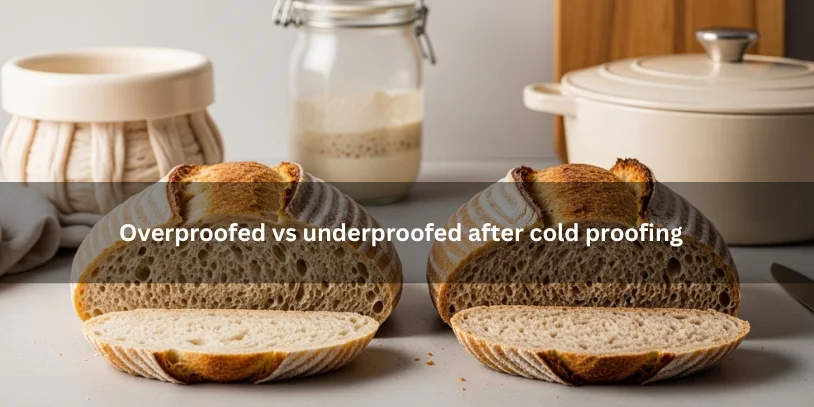
This is the most important comparison because it changes the fix completely.
Overproofed after cold proof
The dough usually feels:
- very soft
- puffy
- sticky
- fragile
- quick to spread
The baked loaf usually has:
- weak oven spring
- flatter shape
- a softer, more even crumb
- less dramatic ear or bloom
Underproofed after cold proof
The dough usually feels:
- firmer
- tight
- less airy than expected
- heavier
- resistant rather than fragile
The baked loaf usually has:
- dense crumb
- limited overall rise
- thick or uneven bursts in the crust
- a somewhat heavy texture
If your dough is puffy and collapses, think overproofed.
If it is cold, dense, and never really looked alive, think underproofed.
What to change first on your next bake
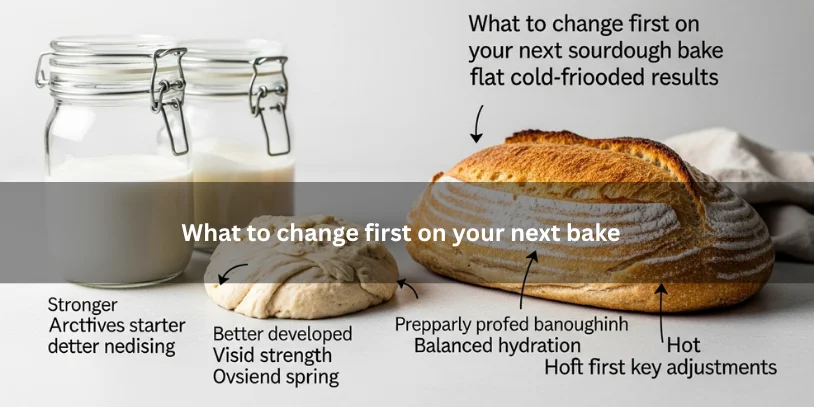
When a loaf goes flat after cold proofing, do not change everything at once. Work in order.
1. Check your starter strength
Use a sourdough starter that is predictably active. It should rise well after feeding, look airy, and smell fresh and fermented rather than dull or exhausted.
If your starter is inconsistent, fix that first. Otherwise every later adjustment becomes guesswork.
2. Watch bulk fermentation more closely
Bulk fermentation matters more than many bakers realize.
Before shaping, the dough should not just look larger. It should also feel lighter, more aerated, and slightly jiggly. If you shape too early, the loaf may go into the fridge underproofed. If you wait too long, the dough may enter the fridge already close to overproofed.
Do not rely only on the clock. Dough temperature, room temperature, inoculation, and flour all change fermentation speed.
3. Control dough temperature
Desired dough temperature can make a huge difference in consistency.
If your dough starts too warm, fermentation runs faster than you think. If it starts too cool, bulk may move too slowly. Using a digital thermometer helps you understand why one bake behaves differently from another.
This is one of the most underrated tools for improving sourdough.
4. Verify fridge temperature
A refrigerator that is too warm can let fermentation continue more actively than expected. One that is too cold can nearly stall proofing.
A practical target for cold proofing is usually around 38°F to 40°F. A fridge thermometer is more useful than trusting the dial.
5. Improve dough strength
If your dough tends to spread, build more structure before blaming the cold proof.
You can do that by:
- mixing more thoroughly at the start
- adding more stretch and folds or coil folds during bulk
- using bread flour instead of weaker flour
- reducing hydration slightly
- giving the dough enough time to strengthen between folds
For many home bakers, slightly lower hydration leads to a taller loaf and better control.
6. Shape with better surface tension
Loose shaping is a common reason a loaf flattens after being removed from the banneton.
Your final shaping should create tension on the outside of the dough without tearing it. That tension supports upward lift. If shaping is too gentle or loose, the loaf relaxes outward instead of rising upward.
7. Bake with stronger heat and steam
A good loaf still needs a good launch.
For better oven spring:
- fully preheat the oven
- preheat the Dutch oven thoroughly
- score with confidence
- bake before the dough warms too much if your method works best from cold
- avoid letting the dough dry out uncovered in the fridge
Common mistakes that lead to flat sourdough after a cold retard
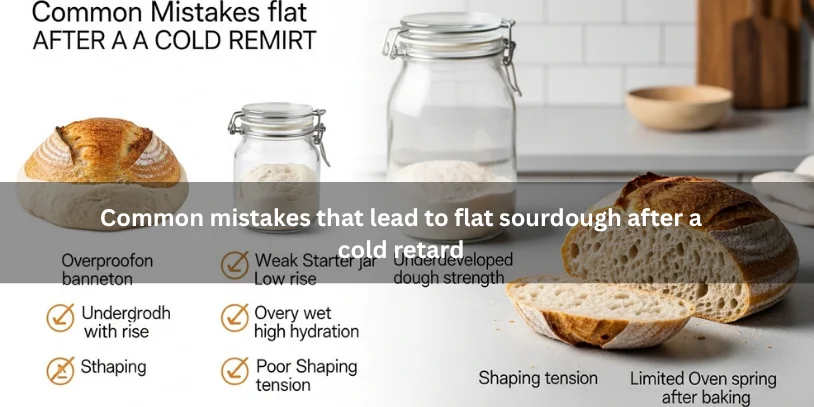
Blaming the fridge first
The refrigerator is often not the root cause. Total fermentation is usually the bigger issue.
Using high hydration too early
Very wet dough can give an open crumb, but it also demands stronger dough development, stronger flour, and better shaping.
Trusting the poke test too much on cold dough
Cold dough behaves differently. The poke test can be less reliable straight from the fridge, especially for beginners.
Ignoring flour strength
Bread flour generally supports taller loaves better than weaker all-purpose flour, especially in lean doughs or higher hydration formulas.
Letting the dough dry out
If the shaped loaf dries in the fridge, it can affect scoring and expansion.
Changing too many variables at once
If you change starter feeding, hydration, bulk time, fridge time, and oven setup all in one bake, you will not know what actually fixed the problem.
A simple decision tree for flat sourdough after cold proofing
Use this when your loaf comes out low and disappointing.
If your dough was puffy, sticky, and fragile:
It likely overproofed. Shorten bulk fermentation slightly or reduce the cold proof time.
If your dough was dense, tight, and not very airy:
It likely underproofed. Let bulk go further before shaping and chilling.
If your dough fermented but kept spreading sideways:
The issue is probably weak dough strength, high hydration, weak flour, or loose shaping.
If the dough looked decent but the loaf still baked flat:
Check oven spring factors such as preheat, steam, Dutch oven heat, and scoring.
If every bake is inconsistent:
Check starter health, dough temperature, and fridge temperature first.
Best tools for diagnosing and fixing the problem
You do not need dozens of gadgets, but a few tools make troubleshooting much easier.
Helpful tools:
- digital thermometer for dough temperature
- fridge thermometer for cold proof accuracy
- banneton for better support during final proof
- Dutch oven for steam and structure
- lame or razor for clean scoring
- straight-sided container for tracking bulk rise
These tools help you stop guessing and start reading the dough more clearly.
What a better next bake looks like
A well-balanced loaf after cold proofing should feel:
- airy but not fragile
- cold but not stiff and lifeless
- easy to score
- supported by surface tension
- ready to spring in a hot oven
When baked, it should show:
- better oven spring
- clearer ear or bloom
- taller profile
- more balanced crumb
- less spreading
That is the goal: not just more rise, but more control.
FAQs
Can sourdough overproof in the fridge?
Yes. Cold proofing slows fermentation, but it does not stop it completely. If the fridge is warm, the proof is long, or the dough already went too far before refrigeration, it can overproof.
Is flat sourdough always overproofed?
No. A flat loaf can also be underproofed, especially if the dough went into a very cold fridge before it had enough fermentation and gas development.
What is the best fridge temperature for cold proofing sourdough?
A practical range is usually around 38°F to 40°F. Too warm can encourage overproofing, while too cold can slow fermentation so much that the loaf remains underproofed.
Should I bake sourdough straight from the fridge?
Many bakers do, especially for easier scoring and better handling. What matters most is whether the dough is properly fermented and well shaped before baking.
Why does my sourdough deflate when scored?
That often points to overproofing or weak structure. If the dough is too fragile, it loses gas when scored instead of opening with controlled oven spring.
Can a weak starter cause flat sourdough after cold proofing?
Yes. A weak starter can lead to poor fermentation, less gas retention, and weak oven spring, even if the rest of the method seems correct.
Does high hydration make sourdough flatter?
It can. High hydration dough is harder to handle and needs stronger gluten development, better shaping, and often stronger flour to hold height.
Why is my dough sticky and slack after proofing?
That can happen when the dough is overproofed, too wet for your flour, underdeveloped, or handled without enough structure-building during bulk fermentation.
Does shaping tension really matter?
Absolutely. Good surface tension helps the loaf hold its shape and rise upward. Loose shaping makes spreading much more likely.
Conclusion
If your sourdough is flat after cold proofing, the answer is usually not just “the fridge was the problem.” Most flat loaves come from one of four bigger causes: overproofing, underproofing, weak starter performance, or dough that never built enough strength.
For your next bake, keep the fix simple. Start with a strong starter, watch bulk fermentation more carefully, check dough and fridge temperature, shape with more tension, and bake in a fully preheated setup with strong steam. Once you work through those variables in order, your sourdough will become much easier to read and much more likely to rise tall instead of spreading flat.